García Fernández, Óscar. “Adscripción de nuevas comedias sueltas inexploradas al taller de imprenta de Simón Fajardo.” Diablotexto Digital, vol. 18, 2026, e33778, pp. 1–21. https://turia.uv.es/index.php/diablotexto/es/article/view/33778.
Ribao Pereira, Montserrat. “Ecos del Siglo de Oro en el drama La Ricahembra (1854), de Manuel Tamayo y Aureliano Fernández-Guerra.” En Enrique Rubio Cremades, Enrico Di Pastena y Julia Bernal Ferriz (eds.), El Romanticismo hispánico ante el Siglo de Oro. Alicante: Biblioteca Virtual Miguel de Cervantes, 2026, pp. 306–323. https://www.cervantesvirtual.com/nd/ark:/59851/bmc1408600.
Escobar Castillo, Andrea. “Desafíos de la transcripción automática de textos en el presente y futuro de CHARTA: el caso del corpus del marqués de Velada.” En Andrés Enrique-Arias, Marina Gomila Albal y Ruth Miguel Franco (eds.), La historia del español a través de sus documentos: coordenadas geográficas y sociales de la variación lingüística. Berlín: Walter de Gruyter, 2026. https://books.google.es/books?id=UooMEgAAQBAJ&pg=PA391.
Rodríguez Nicolás, Sergio. “Juan de Zabaleta, autor de El pleito del demonio con la Virgen (I).” Librosdelacorte.es, núm. 32, 2026, pp. 387–407. DOI: 10.15366/ldc2026.18.32.018.
Marcos Rodríguez, Emma María. “Italia como huella de autoría en algunos textos dramáticos del Siglo de Oro.” En Fernando Candón Ríos, Emanuele Isidori y Ricardo de la Fuente Ballesteros (eds.), Aproximaciones a un patrimonio común: Italia y el mundo hispánico. Valladolid: Universitas Castellae, 2026, pp. 79–96. DOI: https://doi.org/10.5281/zenodo.19038139.
Rodríguez Nicolás, Sergio. “La autoría de Juan de Zabaleta de la primera jornada de Los triunfos de José según el análisis estilístico.” Janus. Estudios sobre el Siglo de Oro, núm. 15, 2026.
Gómez Martos, Francisco. “El disfraz del valido: Payo de Guzmán, protagonista de Cómo ha de usarse del bien y ha de prevenirse el mal.” Bulletin of Hispanic Studies, vol. 103, n.º 5, 2026, pp. 487–501. DOI: https://doi.org/10.3828/bhs.2026.25.
Marcos Rodríguez, Emma María. “Cinco manuscritos autógrafos, pero muchas manos. Mira de Amescua y las copias de los originales de sus comedias.” Anuario Lope de Vega. Texto, literatura, cultura, vol. 32, 2026.
Martínez Carro, Elena. “Marcas autógrafas en los manuscritos de Antonio Martínez de Meneses.” Anuario Lope de Vega. Texto, literatura, cultura, vol. 32, 2026.
Zapatero, Ane. Hacia un análisis de las subtramas amorosas y de los personajes femeninos en las obras hagiográficas de Lope de Vega. Anuario Lope de Vega. Texto, literatura, cultura, vol. 32, 2026.
Rodríguez-Gallego, Fernando. “La reescritura incesante de Calderón y el proceso de composición de sus autógrafos: el caso de «El gran príncipe de Fez».” Anuario Lope de Vega. Texto, literatura, cultura, vol. 32, 2026.
Betti, Miguel. “La comedia nueva en el mapa: reconocimiento automatizado y cartografía digital de topónimos.” Anuario Lope de Vega. Texto, literatura, cultura, vol. 32, 2026.
Vega García-Luengos, Germán. “La mujer por fuerza”, una comedia atribuida a Tirso de Molina que reclama la incorporación al repertorio de Lope de Vega. Anuario Lope de Vega. Texto, literatura, cultura, vol. 32, 2026.
Artamonova, Ekaterina A. “В тени великих. Хуан Баутиста Диаманте и испанский театр XVII века” [“In the Shadow of the Greats: Juan Bautista Diamante and 17th-Century Spanish Theatre”]. HSE University Journal of Art & Design, núm. 10 (2/2026), 2026, pp. 122–139. DOI: https://doi.org/10.17323/3034-2031-2026-10-122-139.
Gilabert, Gastón. “Jerónimo de Cáncer y la versificación de sus comedias colaboradas.” En Marcella Trambaioli y Debora Vaccari (eds.), Ir y quedarse y con quedar partirse: relaciones literarias entrañables: ensayos dedicados a Stefano Arata. Madrid: Visor Libros, 2026, pp. 103–121. (Biblioteca filológica hispana, 316). ISBN 979-13-87745-16-5.
Rojas Zorrilla, Francisco de; y Pedro Calderón de la Barca. Troya abrasada, en Almudena García González, Sergio Rodríguez Nicolás, Óscar García Fernández y José Vicente Salido López (eds.), Comedias áureas de varios ingenios. Tomo III, Cuenca, Ediciones de la Universidad de Castilla-La Mancha, 2026.
González Cañal, Rafael. «Prólogo», en Almudena García González, Sergio Rodríguez Nicolás, Óscar García Fernández y José Vicente Salido López (eds.), Comedias áureas de varios ingenios. Tomo III, Cuenca, Ediciones de la Universidad de Castilla-La Mancha, 2026.
Fiore, Arianna. La donna innamorata da vero di Carlo Gozzi e la tradizione scenica del Pedro de Urdemalas, en Fausta Antonucci y Salomé Vuelta García (eds.), *La recepción del teatro clásico español en Europa (siglos XVII-XVIII)*, Firenze University Press, Firenze, 2026, pp. 165–176.
Rodríguez Becerra, Salvador. “Hagiotopografía y Urbanismo en la provincia franciscana de Los Ángeles.” En Manuel Peláez del Rosal (dir.), El franciscanismo en la memoria hagiotopografía franciscana: barrios, plazas, compases, carreras y calles de ciudades, villas y lugares. Congreso Internacional / XXVII Curso de Verano. Priego de Córdoba, antiguo convento de San Francisco, 18–21 de julio de 2024. Asociación Hispánica de Estudios Franciscanos, 2026, pp. 503–528. ISBN 978-84-120299-6-3.
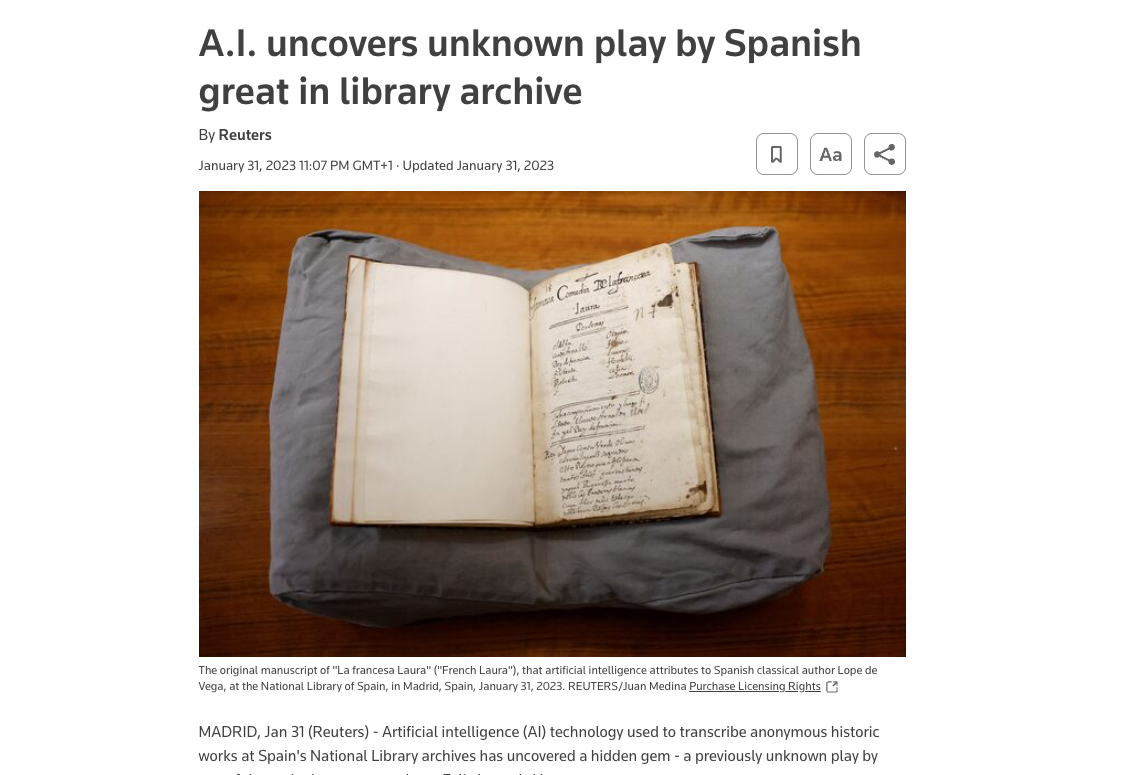
Peralta, Alberto. “Implementing AI in the National Library of Spain: The ETSO Project and Stylometric Analysis of Golden Age Theatre.” En Ines Mergel y Carsten Schmidt (eds.), AI Innovations in Public Services: The Case of National Libraries. Cham: Springer, 2026, pp. 135–150.
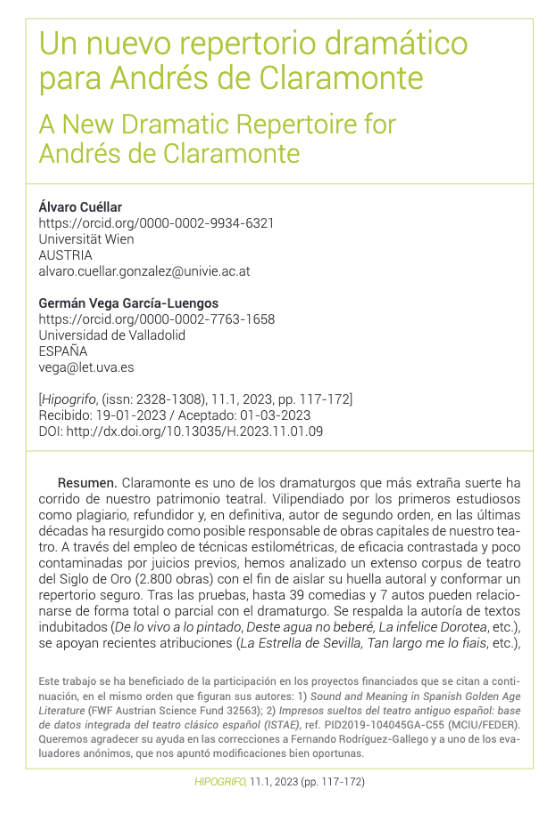
Plaza Liébana, Sandra. Estilometría computacional para la atribución de autoría del teatro del Siglo de Oro: el caso de Andrés de Claramonte y Corroy. Trabajo de fin de grado, Universitat Autònoma de Barcelona, 2026. https://ddd.uab.cat/record/334310.
Iglesias Balsa, Candela. “Un nuevo testimonio de Ni Amor se libra de amor: el manuscrito 26-III-11 de la biblioteca del Instituto Valencia de Don Juan.” Revista de Literatura, vol. 88, núm. 175, 2026, 1648. DOI: https://doi.org/10.3989/revliteratura.2026.01.1648.
Poyatos Dorado, César. Inteligencia artificial y educación: un viaje apasionante. Mensajero, 2026. ISBN 978-84-271-5173-4.
Casariego Castiñeira, Paula. “Las sueltas antiguas de La cruz en la sepultura atribuidas a Calderón de la Barca: nuevos aportes a su tradición textual.” Bulletin of the Comediantes, vol. 77, núms. 1–2, 2026, pp. 117–140. DOI: https://doi.org/10.1353/boc.2026.a1000623.
Medina Díaz, María. Una aproximación textual a la comedia Las Auroras de Sevilla. Trabajo Fin de Grado, Universidad de Sevilla, 2025. https://hdl.handle.net/11441/174963.
Resta, Ilaria. Reseña de Agustín Moreto, Comedias de Agustín Moreto. Tercera parte de comedias, volumen IX, dir. María Luisa Lobato, coord. Gaston Gilabert, eds. Marta Martínez Gutiérrez y Zaida Vila Carneiro. Anuario Lope de Vega. Texto, literatura, cultura, vol. 31, 2025, pp. 286–295. DOI: https://doi.org/10.5565/rev/anuariolopedevega.570.
Aracil Varón, Beatriz. “Indígenas cristianos en el teatro del Siglo de Oro: El Nuevo Mundo descubierto por Cristóbal Colón y su lectura novohispana.” Anuario Lope de Vega. Texto, literatura, cultura, vol. 31, 2025, pp. 150–185. DOI: https://doi.org/10.5565/rev/anuariolopedevega.518.
Lauer, A. Robert. Reseña de Pedro Calderón de la Barca, Las cadenas del demonio, ed. crítica José Elías Gutiérrez Meza y Henrry A. Ibáñez Mogrovejo. Anuario Calderoniano, vol. 18, 2025, pp. 537–539.
Montauban, Jannine. Reseña de Pedro Calderón de la Barca, Las cadenas del Demonio, eds. José Elías Gutiérrez Meza y Henrry A. Ibáñez Mogrovejo, Madrid/Frankfurt, Iberoamericana/Vervuert, 2024, 196 pp. Lexis, vol. 49, núm. 1, 2025, pp. 497–499. DOI: 10.18800/lexis.202501.017.
Rubiera, Javier. “Las dos comedias escritas en colaboración por Martínez de Meneses, Rosete y Cáncer: un estudio comparativo de El arca de Noé y El mejor representante, San Ginés.” eHumanista: Journal of Iberian Studies, vol. 61, 2025, pp. 485–495.
Santana Bustamante, Carmen. La Santa Táez atribuida a Rojas Zorrilla y la de Enríquez Gómez: edición crítica, estudio y análisis comparativo. Tesis doctoral, Universidad de Castilla-La Mancha, 2025.
Castrillo Alaguero, Javier. “De Mira a Moreto: ecos de Cautela contra cautela en El mejor amigo, el rey.” Anuario de Estudios Filológicos, vol. 48, 2025, pp. 25–47.
Otero Romero, Adelia. La escenografía en la obra donjuanesca. Un análisis comparativo de la espacialidad entre El burlador de Sevilla y No hay deuda que no se pague y convidado de piedra. Trabajo Fin de Máster, Universidad de Sevilla, 2025.
García Reidy, Alejandro. “Andrés de Claramonte, «El rey don Pedro en Madrid», ed. Fernando Cantalapiedra Erostarbe, prólogo de Germán Vega García-Luengos.” Anuario Lope de Vega. Texto, literatura, cultura, vol. 31, 2025, pp. 231–238.
Casariego Castiñeira, Paula. “Los impresos sueltos teatrales del tomo CD.122.514 de la Biblioteca Nacional Universitaria de Estrasburgo: noticia bibliográfica.” Janus, núm. 14, 2025.
Fiore, Arianna, ed. Tres entremeses famosos, a modo de comedia, de entretenimiento, de Pedro Ordóñez de Ceballos. Florencia: Società Editrice Fiorentina, 2025. DOI: 10.35948/DILEF/978-88-6032-806-9.
Barrocal, Jorge Ferreira. “El auto sacramental de Escarramán: respaldo filológico de las atribuciones a Claramonte.” Hispanófila, vol. 203, no. 1, 2025, pp. 21–39.
Lara Raírez, Alberto. Propuesta de un análisis estilométrico para las comedias colaboradas de Rojas. eHumanista: Journal of Iberian Studies, vol. 61, 2025, pp. 345–352.
Pacheco Martínez, Irene. Reescritura y traducción del teatro calderoniano en el contexto fundacional de la dramaturgia nacional alemana. Tesis doctoral, Universitat de València, 2025.
García-Reidy, Alejandro. Una comedia en colaboración desatendida y el sitio de Barcelona (1651–1652): El padrino de su afrenta. eHumanista: Journal of Iberian Studies, vol. 61, 2025, pp. 242–259.
Rodríguez Nicolás, Sergio. Una nueva comedia colaborada para Juan de Zabaleta: la primera jornada de Los triunfos de José. eHumanista: Journal of Iberian Studies, vol. 61, 2025, pp. 470–484.
González Cañal, Rafael; María Luisa Lobato; y Almudena García González. El teatro áureo en colaboración. eHumanista: Journal of Iberian Studies, vol. 61, 2025, pp. 136–144. ISSN-e 1540-5877.
López Lorenzo, Cipriano. “«Suceso en menos de seis horas»: un plan de comedia inédito de Fernando de la Torre Farfán.” Revista de Filología Española, vol. 105, núm. 2, 2025.
Campión Larumbe, Miguel. Posibles aplicaciones de la estilometría a la investigación de los métodos de colaboración en las comedias de varios ingenios. eHumanista, vol. 61, 2025, pp. 200–210.
Gilabert Viciana, Gaston. El teatro de Moreto en colaboración: constantes y variables métricas. eHumanista: Journal of Iberian Studies, vol. 61, 2025, pp. 276–289.
Ferreira Barrocal, Jorge. “Adenda a Zurdo, gracioso despiadado de la comedia claramontesca Púsoseme el sol, saliome la luna.” Bulletin of the Comediantes, vol. 76, no. 1, 2025, pp. 39–59. DOI: 10.1353/boc.2025.a970250.
Escudero Baztán, Juan Manuel. Poéticas calderonianas en las comedias colaboradas: el caso de El monstruo de la fortuna, la lavandera de Nápoles, Felipa Catanea. eHumanista: Journal of Iberian Studies, vol. 61, 2025, pp. 219–227.
González Cañal, Rafael. La genealogía burlesca, recurso de los graciosos en el teatro de la generación calderoniana. Hipogrifo: Revista de Literatura y Cultura del Siglo de Oro, vol. 13, no. 1, 2025, pp. 267–291.
González Escudero, Irene. Rojas Zorrilla en colaboración: el caso de También tiene el sol menguante. eHumanista: Journal of Iberian Studies, vol. 61, 2025, pp. 260–275.
Di Pastena, Enrico. Alessandro Martinengo (Savona, 1930–2021): In memoriam. Alicante: Biblioteca Virtual Miguel de Cervantes, 2025. Edición digital a partir de La Perinola: Revista de Investigación Quevediana, núm. 26, 2022, pp. 11–16.
Campbell Manjarrez, Ysla. “Notas sobre la posible autoría alarconiana de El rey muerto atribuido a Vélez de Guevara.” Capítulo en libro, ICSA (CATHI), 2025.
Antonucci, Fausta. “La ejemplaridad de la villana en el teatro áureo: de Lope de Vega a ¿Martínez de Meneses?” En Daria Castaldo, Claudia Colantonio, Giulia Lucchesi, Massimo Marini, Debora Vaccari y Erica Verducci (eds.), El universo femenino entre textos e historia. Temas, escrituras, lenguajes. Tomo II: Literatura y crítica literaria (1). Coordinación de Isabella Tomassetti, 2025.
Ferrer Blé, Laura. “El testimonio único de El loco por fuerza. Claves ecdóticas, problemas textuales y enmiendas.” En Luigi Giuliani y Victoria Pineda (eds.), «No tendrás otros textos»: editar testimonios únicos del teatro del Siglo de Oro. Actas del XVIII Taller Internacional de Estudios Textuales. Rassegna iberistica, vol. 45, 2025.
Cruz Casado, Antonio. “Entre lo popular y lo culto: San Antonio de Padua en la tradición oral cordobesa y en varias comedias clásicas españolas.” En El franciscanismo en la memoria. Hagiotopografía franciscana, 2025.
Fernández Mosquera, Santiago. “Sobre la sostenibilidad de las Humanidades Digitales.” En Guillermo Serés Guillén, Bienvenido Morros Mestres y Laura Fernández García (coords.), Paula Pérez Medina (col.), No importa. Homenaje a Francisco Rico. Bellaterra: Universitat Autònoma de Barcelona / Centro para la Edición de los Clásicos Españoles, 2025, pp. 357–368. ISBN 978-84-09-77565-1.
Prieto Mueller, María Angela. Anatema de Don Juan: en Tirso de Molina y Zorrilla. Análisis filosófico-teológico, tesis de máster, San Francisco State University, San Francisco, 2025.
Sánchez-Hernández, Sara. “La transmisión textual de la comedia colaborada Enfermar con el remedio: una aproximación.” Cuadernos para la Investigación de la Literatura Hispánica, núm. 51, 2025, pp. 243–268.
Ulla Lorenzo, Alejandra, y Paula Casariego Castiñeira. «Identificación de ediciones y transmisión textual de El imposible más fácil: de Calderón a Matos Fragoso». Boletín de la Real Academia Española, 2025, pp. 763–803.
Ferreira Barrocal, Jorge. Estudio y edición de una comedia del siglo XVII: La paciencia en la fortuna. Dir. Héctor Urzáiz Tortajada. Universidad de Valladolid, 2025. Programa de Doctorado en Español: Lingüística, Literatura y Comunicación.
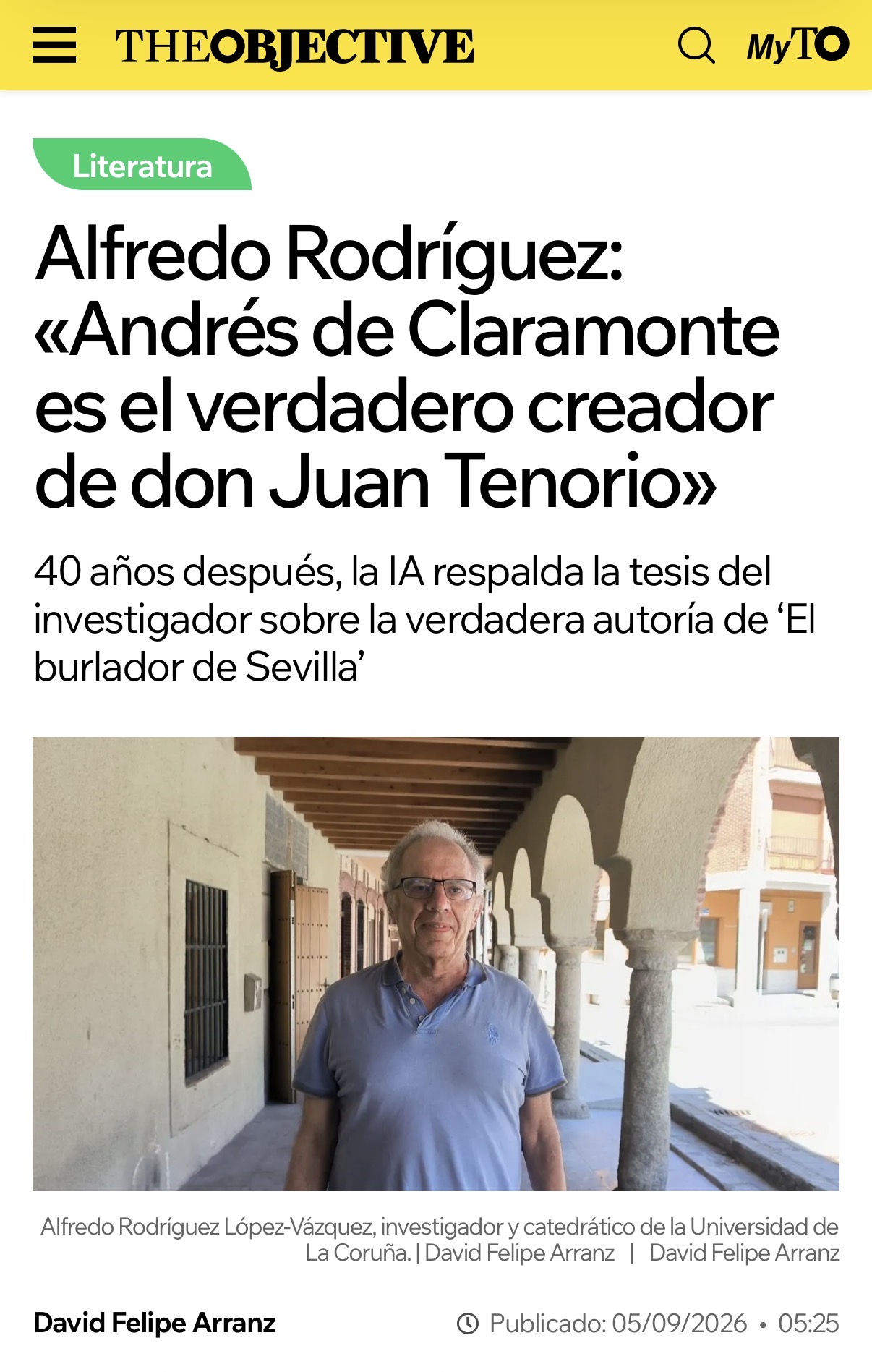
Rodríguez López-Vázquez, Alfredo (ed.). Un auto y dos comedias. Andrés de Claramonte. Murcia: Editum. Ediciones de la Universidad de Murcia, 2025. (Colección Editum Teatro, 18). ISBN 978-84-10172-70-8.
Rucio Zamorano, María José, y Germán Vega García-Luengos. La IA en la Biblioteca Nacional de España: el proyecto ETSO y el fondo de manuscritos teatrales del Siglo de Oro. En La Ciencia y el Arte X: ciencias y tecnologías aplicadas a la conservación del patrimonio, 2025, ISBN 978-84-8181-917-5, pp. 69–83.
González Cañal, Rafael. “Palabras preliminares.” En Obras completas. Volumen X. Comedias sueltas, ed. Rafael González Cañal y Almudena García González. Cuenca: Ediciones de la Universidad de Castilla-La Mancha, 2025.
García-Reidy, Alejandro. “Odres nuevos (digitales) para el teatro áureo español.” En: Arteaga, F., Peirats, A., Calvo Gómez, J. A. y Sánchez, D. (coords.), Humanidades Digitales: innovación, memoria y conexiones culturales en la era tecnológica, Valencia, Tirant lo Blanch, 2025, pp. 113–138.
Vaccari, Debora. “Mujeres forzadas y Derecho castellano en el teatro del Siglo de Oro.” En Ana Macannuco Rodríguez (ed.), Horizontes de género: lenguajes, identidades y resistencias. Dykinson, 2025, pp. 235–259. ISBN 979-13-7006-246-0.
Alonso Medel, Rocío. El divino portugués, san Antonio de Padua: una comedia hagiográfica, varias versiones y ¿un mismo autor? En Sònia Boadas, Arantxa Llàcer y Eulàlia Miralles (eds.), In nova forma: Reescrituras de la literatura del Barroco. Kassel: Edition Reichenberger, 2025.
Hernández Tornero, Celio. La reescritura de la crónica valenciana de Pere Antoni Beuter: otra mirada con perspectiva digital. En Sònia Boadas, Arantxa Llàcer y Eulàlia Miralles (eds.), In nova forma: Reescrituras de la literatura del Barroco. Kassel: Edition Reichenberger, 2025.
Vega García-Luengos, Germán. El teatro español del siglo XVII en la imprenta: un estado de la cuestión y perspectivas. En Comedias Sueltas USA, Essays, 2025.
Vega García-Luengos, Germán. Para la restitución a Tirso de Molina de Los terceros de San Francisco, comedia atribuida a Lope de Vega y Pérez de Montalbán. En Teresa Gómez Trueba, Patricia Marín Cepeda, María Martínez Deyros y Carmen Morán Rodríguez (eds.), «Claro espejo donde la ilusión se mira». Homenaje a Pilar Celma Valero y Javier Blasco Pascual. Valladolid: Ediciones Universidad de Valladolid, 2025, pp. 695–716. ISBN 978-84-1320-348-5.
Zabaleta, Juan de; Martínez de Meneses, Antonio; Rosete Niño, Pedro; Villaviciosa, Sebastián de; Cáncer y Velasco, Jerónimo; y Moreto, Agustín. El rey don Enrique, el Enfermo. Ed. crítica de Sergio Rodríguez Nicolás. Alicante: Biblioteca Virtual Miguel de Cervantes, 2025. (Colección Digital PROTEO, 26). ISBN 978-84-1143-987-9.
Rojas Zorrilla, Francisco de. Santa Táez. En Obras completas. Volumen X. Comedias sueltas, ed. Rafael González Cañal y Almudena García González. Cuenca: Ediciones de la Universidad de Castilla-La Mancha, 2025.
Walde-Moheno, Lillian von der. Muerte en escena y otros aspectos de la dramaturgia alarconiana. En Las caras de la huesuda. Variaciones sobre la muerte en el teatro hispánico, 2025, pp. 305–326.
Vega García-Luengos, Germán. Más evidencias y consideraciones sobre la controvertida «Segunda parte de comedias» de Tirso de Molina. En Guillermo Serés, Bienvenido Morros y Laura Fernández (eds.), No importa. Homenaje a Francisco Rico. Bellaterra: Centro para la Edición de los Clásicos Españoles, Universitat Autònoma de Barcelona, 2025, pp. 1037–1055.
Rojas Zorrilla, Francisco de. La hermosura en la desdicha. En Obras completas. Volumen X. Comedias sueltas, ed. Rafael González Cañal y Almudena García González. Cuenca: Ediciones de la Universidad de Castilla-La Mancha, 2025.
Moreto, Agustín (atribuida). La ocasión hace al ladrón. Texto base de Elena Muñoz. Alicante: Biblioteca Virtual Miguel de Cervantes, 2025. URI: https://www.cervantesvirtual.com/nd/ark:/59851/bmc1333632.
Vélez de Guevara, Luis. El Conde don Sancho Niño. Segunda edición crítica y anotada (versión digital) de William R. Manson y C. George Peale; estudio introductorio de Daniele Crivellari. Alicante: Biblioteca Virtual Miguel de Cervantes, 2025.
Fuente Rams, Martina de la. Hacia una edición crítica de la comedia Vida, muerte y colocación de San Isidro a partir del manuscrito a seis manos. Trabajo Final de Grado, Universitat de Barcelona, 2025. Tutor: Gaston Gilabert Viciana.
Belmonte Bermúdez, Luis de. El ollero de Ocaña. Edición crítica y anotada de C. George Peale. Santa Barbara: Publications of eHumanista, 2025.
Alonso Medel, Rocío. Reseña de Juan Pérez de Montalbán, Obras. Segundo tomo de comedias. Volumen 2.4, ed. general María Moya, eds. Davinia Rodríguez Ortega, Mónica García Quintero y Claudia Demattè. Anuario Lope de Vega. Texto, literatura, cultura, vol. 30, 2024, pp. 482–488. DOI: https://doi.org/10.5565/rev/anuariolopedevega.528.
Rodríguez Nicolás, Sergio. “Juan de Zabaleta como colaborador dramático.” Hipogrifo. Revista de Literatura y Cultura del Siglo de Oro, vol. 12, no. 1, 2024, pp. 265–281. DOI: https://doi.org/10.13035/H.2024.12.01.17.
Gunter, Ben; Susan Paun de García; Anthony Grubbs; Kathleen Costales; Ian M. Borden; Carmen Ruiz Sánchez; Alejandra Juno Rodríguez Villar; y Kerry Wilks. “Calderón Onstage in Spanish Florida: Context, Text, and Reconstruction.” En Susan Paun de García, Esther Fernández, Erin A. Cowling y Glenda Nieto Cuebas (eds.), La comedia entre mundos: intersecciones críticas en el teatro de la temprana modernidad / The Comedia Between Worlds. Santander: Sociedad Menéndez Pelayo, 2024, pp. 213–237. DOI: https://doi.org/10.55422/ppsmp.9.11.
Massanet Rodríguez, Rafael. De El celoso prudente a Del rey abajo, ninguno: revisionismo crítico y análisis comparativo de sus conexiones literarias. Symposium: A Quarterly Journal in Modern Literatures, vol. 78, no. 3, 2024.
Hernando Morata, Isabel. “Notas sobre la primera jornada del manuscrito de Troya abrasada de Calderón (¿y Rojas Zorrilla?) Res. 78 de la BNE.” Bulletin Hispanique, vol. 127, no. 1, 2024, pp. 107–128.
Hicks-Bartlett, Alani. “«¡Qué bien lo finges!»: On the Performance of Melancholy and Disability in El príncipe melancólico.” eHumanista, vol. 59, 2024.
García-Reidy, Alejandro. La muerte del autor atribuido en el teatro áureo. Ínsula: Revista de Letras y Ciencias Humanas, no. 930, 2024, pp. 9–12.
Massanet Rodríguez, Rafael. Entre Matos, Moreto y Pérez de Montalbán: El príncipe prodigioso y sus problemas de atribución. Hipogrifo: Revista de Literatura y Cultura del Siglo de Oro, vol. 12, no. 1, 2024, pp. 247–264.
Rodríguez López-Abadía, Arturo. «Dos obras para el repertorio de José de Valdivielso: La gitana de Menfis y El animal profeta, a la luz del Condenado por desconfiado». Lemir: Revista de Literatura Española Medieval y del Renacimiento, no. 28, 2024, pp. 195–204.
Alonso Medel, Rocío. “Los autógrafos de Juan Pérez de Montalbán (1601–1638): el caso de El caballero del Febo.” Bulletin Hispanique, vol. 127, no. 1, 2024, pp. 63–80.
Vega García-Luengos, Germán. Lope de Vega y la comedia en colaboración. Un replanteamiento novedoso. Hipogrifo: Revista de Literatura y Cultura del Siglo de Oro, vol. 12, no. 1, 2024, pp. 105–142.
Gómez Sánchez-Ferrer, Guillermo. La construcción de la comedia de enredo de Juan Ruiz de Alarcón: a propósito de El desdichado en fingir. Atalanta. Revista de las Letras Barrocas, vol. 12, no. 2, 2024, pp. 66–93.
Abate, Anna; y Lorenzo Bocchi. Herramientas digitales para la edición del teatro aurisecular: el informe de una tentativa a partir de EVT (Edition Visualization Technology). Revista de Humanidades Digitales, vol. 9, 2024, pp. 114–131.
Campión Larumbe, Miguel. Textos con más de un autor y su estudio mediante técnicas de estilometría. Ínsula: revista de letras y ciencias humanas, n.º 930, 2024 (Ejemplar dedicado a: Inteligencia artificial y cuantificación estilística en las letras hispánicas), págs. 12–17. ISSN 0020-4536.
Gilabert, Gaston. “Métrica teatral y marcas autoriales en las comedias colaboradas: el caso de Diamante y otros ingenios de consuno.” Hipogrifo: Revista de Literatura y Cultura del Siglo de Oro, vol. 12, no. 1, 2024, pp. 159–171. DOI: 10.13035/H.2024.12.01.11.
Tronch Pérez, Jesús. Editar en TEI teatro clásico español e inglés en los proyectos ARTELOPE y EMOTHE. Studia Aurea Monográfica, no. 9, 2024, pp. 49–64.
Marcos Rodríguez, Emma María. Sentido y pervivencia del teatro de Antonio Mira de Amescua. Dir. Germán Vega García-Luengos y Héctor Urzáiz Tortajada. Valladolid: Universidad de Valladolid, 2024. DOI: 10.35376/10324/69443.
Samson, Alexander. Marking Time: Framing the comedia between the 16th and 21st Centuries. En La comedia entre mundos: intersecciones críticas en el teatro de la temprana modernidad. Sociedad Menéndez Pelayo, 2024, pp. 363–384. DOI: 10.55422/ppsmp.9.18.
Gutiérrez Valencia, Cristina. Tantas veces Lope: la autoconfiguración del primer autor moderno. Valladolid: Ediciones Universidad de Valladolid, 2024. (Colección Olmedo Clásico). ISBN 978-84-1320-296-9. DOI: https://doi.org/10.24197/eduva.2992.
Toro Nader, Mariana. Arqueología digital: en busca del archivo perdido. Anuario AC/E de cultura digital, año 2024, págs. 57–69. (Ejemplar dedicado a: Focus: análisis internacional sobre el uso de las lenguas minoritarias en la cultura digital). ISSN 2952-525X.
Martínez Gutiérrez, Míriam. Teatro barroco español en Europa: la proyección de Agustín Moreto en Francia. Tesis doctoral, Universidad de Burgos, 2024.
Alonso Medel, Rocío. “Los autógrafos de Juan Pérez de Montalbán (1601–1638): el caso de ‘El caballero del Febo’.” Bulletin hispanique, vol. 126, no. 1, 2024, pp. 63–80.
Sánchez Ibáñez, Francisco. La práctica colaborativa en el teatro de Agustín Moreto. Tesis doctoral, Universidad de Burgos, 2024. Dir. María Luisa Lobato López y Alicia Vara López.
Gilabert, Gaston. La música en el teatro de Ruiz de Alarcón. Atalanta. Revista de las Letras Barrocas, vol. 12, no. 2, 2024, pp. 32–65.
Ferrer Valls, Teresa. Dos obras de Rodrigo de Herrera en el contexto de la polémica sobre el patronazgo de Santiago: El voto de Santiago y batalla de Clavijo y El primer templo de España y segundo obispo de Ávila. En Cultura de defensa en la literatura española desde el Siglo de Oro (Biblioteca Áurea Hispánica, 165). Madrid–Frankfurt: Iberoamericana / Vervuert, 2024, pp. 33–48.
Enríquez Gómez, Antonio. El obispo de Crobia, san Estanislao. Edición crítica, prólogo y notas de Sergio Rodríguez Nicolás. Alicante: Biblioteca Virtual Miguel de Cervantes, 2024. ISBN 978-84-1143-945-9.
Boadas, Sònia. Literatura áurea y Humanidades Digitales: un trienio de constante progresión (2020-2023). Aureae Litterae Ovetenses: Actas del XIII Congreso de la AISO, 2024, pp. 153-172.
Lope de Vega. El robo de Dina. Edición de José Enrique López Martínez. En Comedias. Parte XXIII (2 vols.). Coord. Fernando Rodríguez-Gallego. Madrid: Gredos, 2024. ISBN 978-84-249-4113-0.
Resta, Ilaria. “Investigaciones sobre el teatro del Siglo de Oro en el trienio 2020–2023: balance y perspectivas.” Aureae Litterae Ovetenses: Actas del XIII Congreso de la AISO, 2024, pp. 217–235.
García-Reidy, Alejandro. Dos copias manuscritas localizadas: La serrana de Tormes, de Lope, y El bien nacido encubierto, no de Lope. 2024.
Vuelta García, Salomé. “Audiencias del rey don Pedro: algunas calas.” En Gema Cienfuegos Antelo; Pedro Conde Parrado; Javier J. González Martínez; Raquel Gutiérrez Sebastián; Borja Rodríguez Gutiérrez; y Héctor Urzáiz Tortajada (coords.), Un caballero para Olmedo: homenaje al profesor Germán Vega García-Luengos, vol. 2, 2024, pp. 979–987. ISBN 978-84-1320-292-1.
Muguruza Roca, María Isabel. “Análisis del discurso e historia social: Un proyecto para el estudio de la literatura como agente histórico a través del análisis del teatro barroco (apuntes metodológicos).” En José Ángel Achón Insausti; Javier Esteban Ochoa de Eribe; y María Isabel Muguruza Roca (coords.), Respuestas sociales en tiempos de crisis: Entre la historia, la literatura y el discurso. Ediciones Trea, 2024, pp. 23–42.
Godínez, Felipe. El primer condenado. Introducción, edición crítica y notas de Irene G. Escudero. Alicante: Biblioteca Virtual Miguel de Cervantes, 2024. (Colección Obra dramática de Felipe Godínez, 1). ISBN 978-84-1143-944-2.
Claramonte y Corroy, Andrés de. El rey don Pedro en Madrid. Edición, introducción, cotejos y notas de Fernando Cantalapiedra Erostarbe; prólogo de Germán Vega García-Luengos. Alicante: Biblioteca Virtual Miguel de Cervantes, 2024. ISBN 978-84-1143-983-1.
Thacker, Jonathan. “A ninguno imitó; nació para maestro, y no discípulo: Calderón’s Early Debt to Lope de Vega and Others.” Comedia Performance, vol. 21, no. 1, 2024, pp. 203–218.
Santos de la Morena, Blanca; Guillermo Gómez Sánchez-Ferrer; y Alba Carmona Lázaro (eds.). Lope después de Lope. Su difusión y fortuna, de la «Fama póstuma» a nuestros días. Kassel: Edition Reichenberger, 2024, vi + 274 pp. (Estudios de Literatura, 152). ISBN 978-3-96728-065-4.
Lope de Vega. La envidia de la nobleza. Edición de Cipriano López Lorenzo. En Comedias. Parte XXIII (2 vols.). Coord. Fernando Rodríguez-Gallego. Madrid: Gredos, 2024. ISBN 978-84-249-4113-0.
Gómez-Caballero, Iván. “La trayectoria escénica de Antonio Coello Ochoa en el siglo XVII.” En Carlos Mata Induráin; y Ariel Núñez Sepúlveda (eds.), «Nulla Dies»: Actas del XIII Congreso Internacional Jóvenes Investigadores Siglo de Oro (JISO). Pamplona: Universidad de Navarra, Colección BIADIG, 2024, pp. 299–322.
Rodríguez Nicolás, Sergio. Rojas Zorrilla en la fragua colaboradora: el autógrafo de La más hidalga hermosura. Edad de Oro, vol. 43, 2024, pp. 399–424.
Marcello, Elena E. “El ‘gongorismo’ de Cubillo de Aragón.” En Gema Cienfuegos Antelo; Pedro Conde Parrado; Javier J. González Martínez; Raquel Gutiérrez Sebastián; Borja Rodríguez Gutiérrez; y Héctor Urzáiz Tortajada (coords.), Un caballero para Olmedo: homenaje al profesor Germán Vega García-Luengos, vol. 2, 2024, pp. 635–644. ISBN 978-84-1320-292-1.
Lope de Vega. Porfiar hasta morir. Edición de Enrico Di Pastena. En Comedias. Parte XXIII (2 vols.). Coord. Fernando Rodríguez-Gallego. Madrid: Gredos, 2024. ISBN 978-84-249-4113-0.
Lope de Vega. Los palacios de Galiana. Edición de Fausta Antonucci. En Comedias. Parte XXIII (2 vols.). Coord. Fernando Rodríguez-Gallego. Madrid: Gredos, 2024. ISBN 978-84-249-4113-0.
Matos Fragoso, Juan de y Agustín Moreto. El príncipe prodigioso. Edición crítica de Rafael Massanet Rodríguez. Alicante: Biblioteca Virtual Miguel de Cervantes, 2024. (Colección Digital PROTEO, 25). ISBN 978-84-1143-955-8.
Cappelli, Federica. “Formas de protesta en una comedia del Siglo de Oro: «El prodigioso Príncipe transilvano».” La Perinola, 2024, pp. 43–57.
Lope de Vega. Dios hace reyes. Edición de Elena Truan y Alejandro García-Reidy. En Comedias. Parte XXIII (2 vols.). Coord. Fernando Rodríguez-Gallego. Madrid: Gredos, 2024. ISBN 978-84-249-4113-0.
Lorenzo, Alejandra Ulla. Preservar, describir e identificar comedias sueltas antiguas: incógnitas y hallazgos bibliográficos. En Demattè, Claudia; Llàcer, Arantxa; y Presotto, Marco (eds.), Imprenta y literatura española en los siglos XVI y XVII: de las periferias al centro. Venecia: Edizioni Ca’ Foscari, 2024, pp. 125–138.
Vega García-Luengos, Germán. “La cara oculta del repertorio de Alarcón. Propuestas de incorporación de dos comedias nuevas: El vencido vencedor y La lealtad en la traición.” Edad de Oro, vol. 43, 2024, pp. 31–92.
Falivene, Samuele. “El conde don Sancho Niño, edición de William R. Manson y C. George Peale.” Orillas: Rivista d’Ispanistica, nº 13, 2024, pp. 965–967. ISSN 2280-4390.
Muñoz Rodríguez, Elena. “Honor, patria o destino: razones para un desenlace inesperado en Con partes nunca hay ventura, comedia palatina de Jacinto Cordeiro.” En Isabel Muguruza Roca y Carlos Mota Placencia (eds.), «La verde oliva y el laurel sagrado». Estudios in memoriam José Javier Rodríguez Rodríguez. Leioa: Universidad del País Vasco / Euskal Herriko Unibertsitatea, 2024, pp. 311–329. ISBN 978-84-1319-621-3.
Rubiera, Javier; y Alejandro García-Reidy (eds.). El teatro en el teatro: dos comedias sobre San Ginés, actor. Alemania: Edition Reichenberger, 2024. (Teatro del Siglo de Oro. Ediciones Críticas, 238). ISBN 9783967280616.
Gilabert, Gaston. Usos métricos de Matos, Diamante y Vélez de Guevara en El hidalgo de la Mancha: comedia en colaboración y teatro breve. En Emilio Martínez Mata; María Fernández Ferreiro; y María Álvarez Álvarez (eds.), Aureae Litterae Ovetenses: Actas del XIII Congreso de la AISO, Oviedo: Universidad de Oviedo, 2024, pp. 285–297.
González Cañal, Rafael. Rojas Zorrilla y su colaboración dramática con Jerónimo de Villanueva. Aureae Litterae Ovetenses: Actas del XIII Congreso de la AISO, 2024, pp. 299–312.
Crivellari, Daniele. Una nueva aportación para el estudio del teatro áureo de tema caballeresco. Aureae Litterae Ovetenses: Actas del XIII Congreso de la AISO, 2024, pp. 269-284.
Gómez Caballero, Iván. El mito de Ulises en el teatro español del siglo XVII. Dir. Rafael González Cañal. Universidad de Castilla-La Mancha, 2024.
Iglesias Balsa, Candela. “Las humanidades digitales al servicio de los estudios de teatro áureo: el caso de El segundo Escipión.” En Alejandra Ulla Lorenzo (coord.), Dixitalidade(s) e tecnoloxía(s) nos ámbitos literarios, culturais e lingüísticos. 2024, pp. 15–22. ISBN 978-84-10142-220.
Valdés Gázquez, Ramón. “Por la dignidad del texto: El teatro del Siglo de Oro y de Lope de Vega en la red. Principios ecdóticos y de Humanidades Digitales.” Editar el Siglo de Oro en la era digital, 2024, pp. 71–108.
Demattè, Claudia. Humanidades digitales y motivos caballerescos: sinergia entre los estudios teatrales y la base de datos MeMoRam. En Gema Cienfuegos Antelo et al. (coords.), Un caballero para Olmedo: homenaje al profesor Germán Vega García-Luengos. Valladolid: Ediciones Universidad de Valladolid, 2024, pp. 287–295.
Gilabert Viciana, Gaston. Notas para un nuevo método de verificación de autorías en el teatro áureo: a propósito de la música de El Anticristo. En Gema Cienfuegos Antelo et al. (coords.), Un caballero para Olmedo: homenaje al profesor Germán Vega García-Luengos. Valladolid: Ediciones Universidad de Valladolid, 2024, pp. 449–457.
Lara Ramírez, Alberto. La hermosura y la desdicha: problemas de autoría en una comedia atribuida a Rojas. En Carlos Mata Induráin y Ariel Núñez Sepúlveda (eds.), Nulla dies. Actas del XIII Congreso Internacional Jóvenes Investigadores Siglo de Oro (JISO 2023), Pamplona: Servicio de Publicaciones de la Universidad de Navarra, 2024, pp. 383–397.
Boadas Cabarrocas, Sònia, y Laura Fernández García. La lista de El peregrino en 1618: atribuciones fiables y apócrifas de Lope de Vega. En Gema Cienfuegos Antelo, Pedro Conde Parrado, Javier J. González Martínez, Raquel Gutiérrez Sebastián, Borja Rodríguez Gutiérrez y Héctor Urzáiz Tortajada (coords.), Un caballero para Olmedo: homenaje al profesor Germán Vega García-Luengos. Vol. 1. Valladolid: Ediciones Universidad de Valladolid, 2024, pp. 165–174.
González Escudero, Irene. Dos títulos para una comedia bíblica en busca de autor (o autores). En Gema Cienfuegos Antelo et al. (coords.), Un caballero para Olmedo: homenaje al profesor Germán Vega García-Luengos. Valladolid: Ediciones Universidad de Valladolid, 2024, pp. 309–320.
Veloso, María José Alonso. “La zurriaga: unas «octavas seriojocosas» atribuidas a Quevedo.” Mélanges de la Casa de Velázquez, no. 54-1, 2024, pp. 233–274.
Ferrer-Blé, Laura. Análisis del género teatral en el caso de El loco por fuerza, una comedia atribuida a Lope de Vega. 2024.
Demattè, Claudia; Arantxa Llàcer; y Marco Presotto. Imprenta y literatura española en los siglos XVI y XVII: de las periferias al centro. Vol. 38. Venecia: Edizioni Ca’ Foscari, 2024.
Casariego Castiñeira, Paula, y Alejandra Ulla Lorenzo. Las atribuciones fraudulentas a Calderón en impresos sueltos: limitaciones y posibilidades. En Gema Cienfuegos Antelo, Pedro Conde Parrado, Javier J. González Martínez, Raquel Gutiérrez Sebastián, Borja Rodríguez Gutiérrez y Héctor Urzáiz Tortajada (coords.), Un caballero para Olmedo: homenaje al profesor Germán Vega García-Luengos. Vol. 1. Valladolid: Ediciones Universidad de Valladolid, 2024, pp. 195–205.
Clavijo Corchero, Álvaro. “Digital Bretón. Una nueva base de datos sobre la obra de Manuel Bretón de los Herreros.” En Gisella Policastro Ponce y Manuel Bermúdez Vázquez (coords.), Cruce de caminos: visiones interdisciplinares en las ciencias sociales y humanidades. Madrid: Dykinson, 2024, pp. 176–194. ISBN 978-84-1070-250-9.
Pérez de Montalbán, Juan. Santo Domingo en Soriano. Edición crítica de Rocío Alonso Medel. Alicante: Biblioteca Virtual Miguel de Cervantes, 2024. (Colección Montalbán Digital, 1). ISBN 978-84-1143-942-8.
Gutiérrez Meza, José Elías, y Henrry A. Ibáñez Mogrovejo (eds.). Las cadenas del Demonio, de Pedro Calderón de la Barca. Madrid / Frankfurt: Iberoamericana Vervuert, 2024.
Cagninelli, Claudia; Daniela Capra; Ulrike A. Kaunzner; y Chiara Preite. “Transformaciones de los enfoques de investigación en el discurso digital / Transformationen linguistischer Ansätze im digitalen Diskurs / Transformations des approches linguistiques des discours numériques.” Lingue e Linguaggi, vol. 65, 2024, pp. 7–38. DOI: https://doi.org/10.1285/i22390359v65p7.
Ferreira Barrocal, Jorge. “La paciencia en la fortuna: una obra de Claramonte erróneamente atribuida a Lope de Vega.” Anuario Lope de Vega, vol. 29, 2023, pp. 199–223.
Resta, Ilaria. La textura tragicómica en los dramas de Lope inspirados en las novelle de Giraldi Cinzio. Revista de Filología Románica, vol. 40, 2023, pp. 59–69.
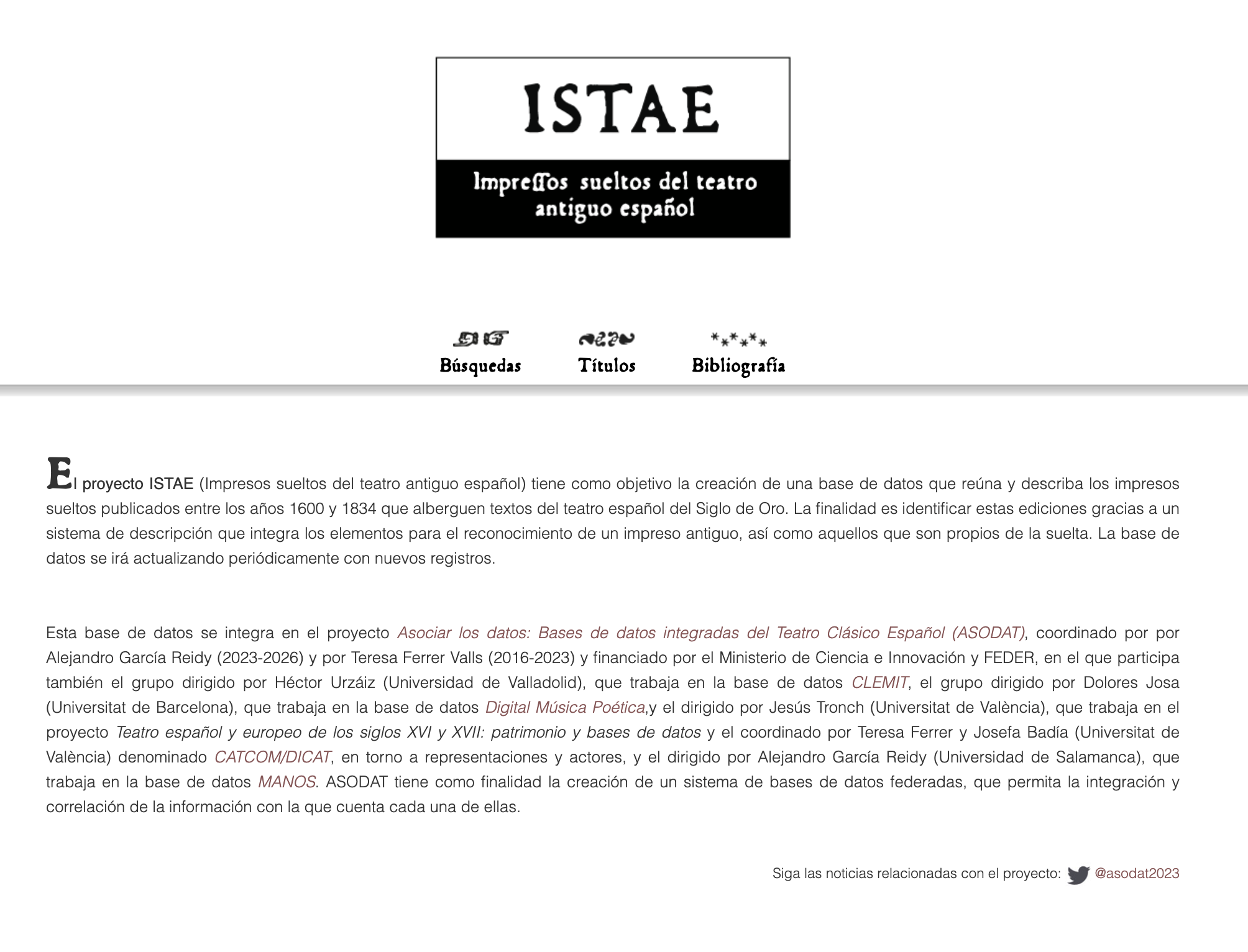
Ferrer Valls, Teresa, y Ariadna Fuertes Seder. “Fundamentos y ampliación de la federación de bases de datos sobre teatro clásico español ASODAT (segunda fase).” Hipogrifo: Revista de Literatura y Cultura del Siglo de Oro, vol. 11, no. 1, 2023, pp. 15–37.
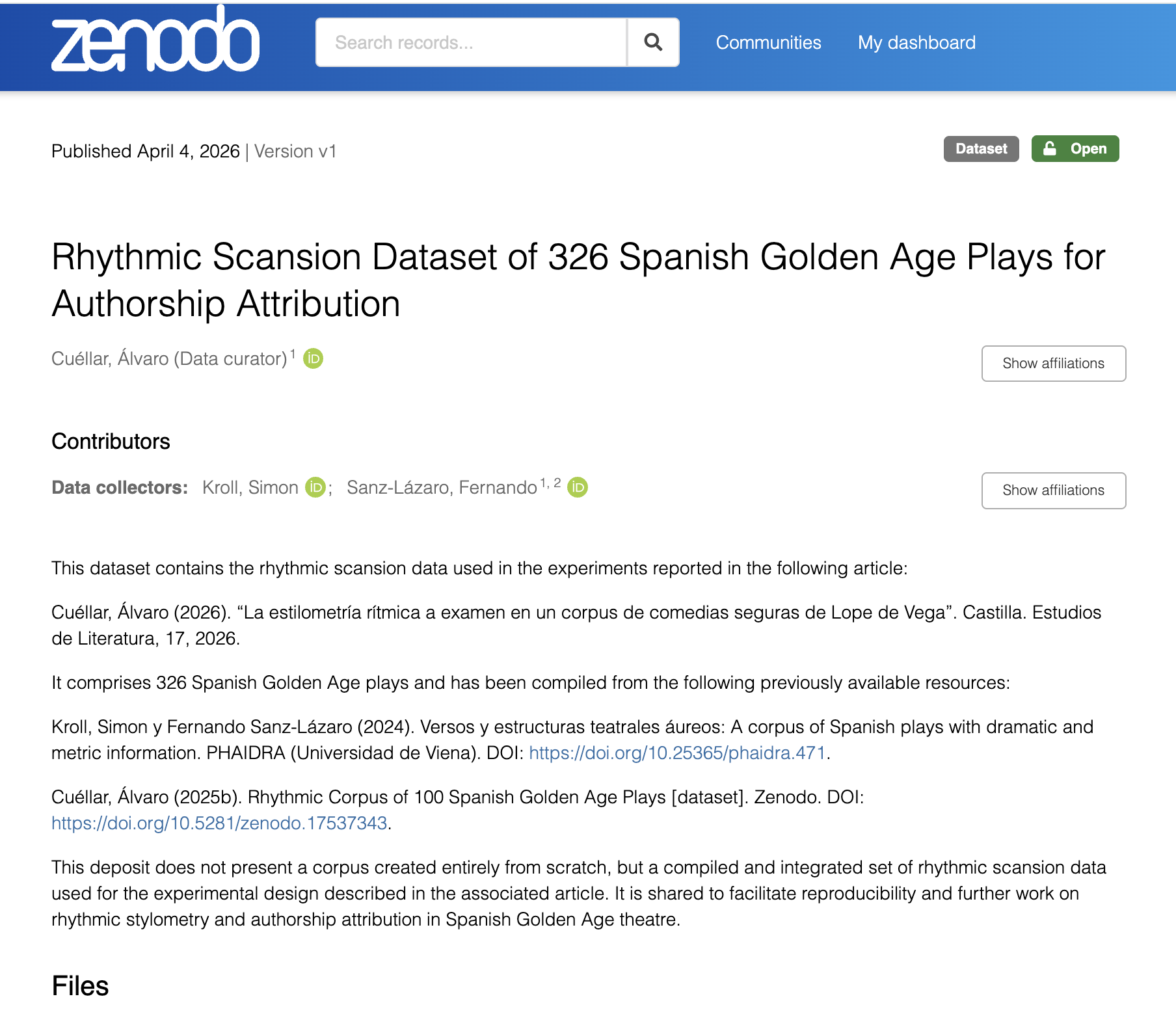
Kroll, Simón; y Fernando Sanz-Lázaro. “Ritmo e inteligencia artificial: nuevas perspectivas sobre teatro lopesco desde las Humanidades Digitales.” Anuario Lope de Vega. Texto, literatura, cultura, vol. 29, 2023, pp. 351–375.
Rodríguez-Gallego, Fernando. “Entre Lope y Calderón: ecos de ¡Ay, verdades, que en amor…! en El astrólogo fingido.” Anuario Lope de Vega. Texto, literatura, cultura, vol. 29, 2023, pp. 431–468.
Fernández Rodríguez, Daniel; y Alejandro García-Reidy. “Una nueva obra para Cepeda desde la filología digital y analógica: Las burlas y enredos de Benito.” Hipogrifo: Revista de Literatura y Cultura del Siglo de Oro, vol. 11, no. 1, 2023, pp. 173–195.
Santos, Héctor Brioso. “El caballero, comedia famosa… ¿de don Agustín Moreto?” Hipogrifo: Revista de Literatura y Cultura del Siglo de Oro, vol. 11, no. 2, 2023, pp. 469–485.
Ros-Fábregas, Emilio. “Musicología en la era de la inteligencia artificial (IA).” Anuario Musical, núm. 78, 2023, pp. 7–12. DOI: https://doi.org/10.3989/anuariomusical.2023.78.01.
Rodríguez-Gallego, Fernando. “Identificación de ediciones de comedias trabajando con la base de datos ISTAE: sobre unas sueltas de La sibila del oriente y gran reina de Sabá, de Calderón.” Hipogrifo: Revista de Literatura y Cultura del Siglo de Oro, vol. 11, no. 1, 2023, pp. 429–462.
Calderón de la Barca, Pedro; Francisco de Rojas Zorrilla; y Antonio Coello y Ochoa. Comedias áureas de varios ingenios. Tomo I: Los privilegios de las mujeres; El jardín de Falerina; El monstruo de la fortuna. Ed. Laura Hernández González, Felipe B. Pedraza Jiménez, Rafael González Cañal y Milagros Rodríguez Cáceres. Cuenca: Ediciones de la Universidad de Castilla-La Mancha, 2023. ISBN 978-84-9044-623-2.
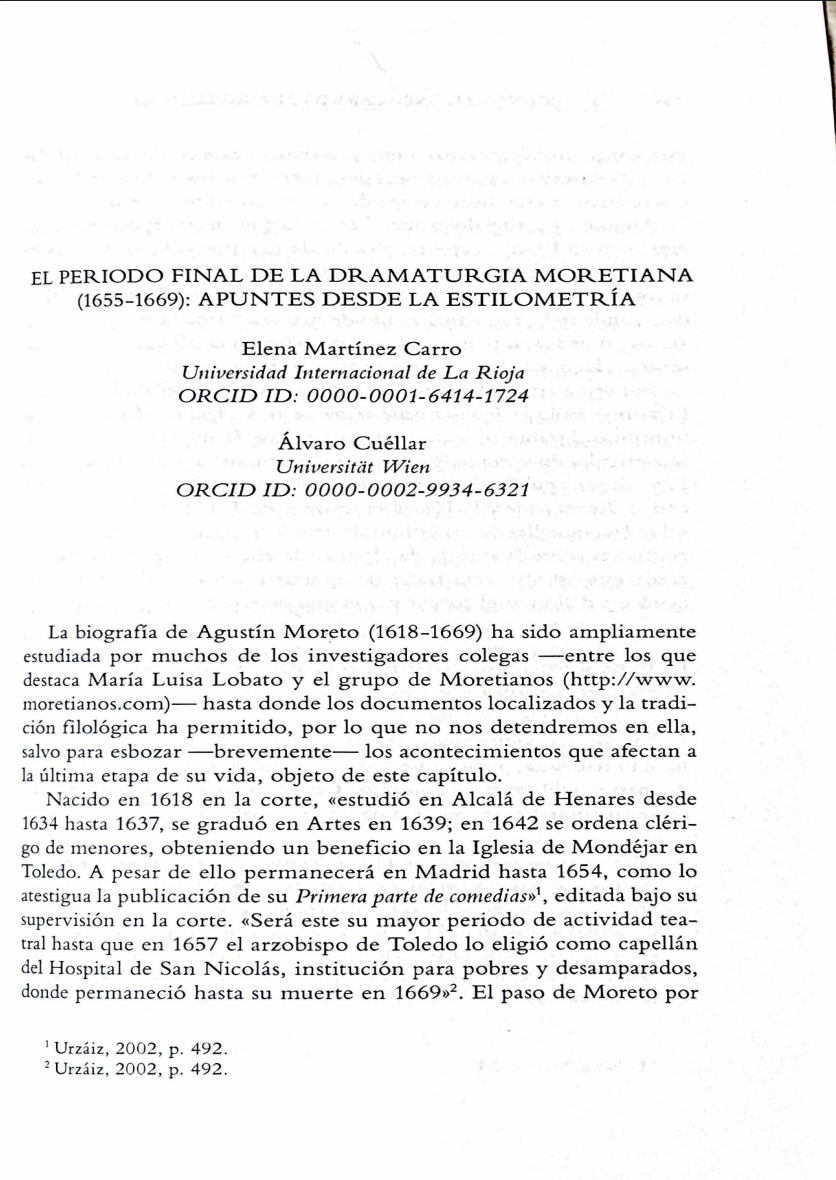
García Fernández, Óscar. “Seis sueltas conservadas en la BNE, posiblemente del impresor Simón Fajardo.” Hipogrifo: Revista de Literatura y Cultura del Siglo de Oro, vol. 11, no. 1, 2023, pp. 223–240.
Ribes, Clara Monzó. “La confusión de un retrato, de Francisco de Medina: autoría, título y representaciones.” Hipogrifo: Revista de Literatura y Cultura del Siglo de Oro, vol. 11, no. 1, 2023, pp. 365–379.
González Martínez, Javier J. “La autoría de Los valles de Sopetrán a la luz de la censura.” Hipogrifo: Revista de Literatura y Cultura del Siglo de Oro, vol. 11, no. 1, 2023, pp. 267–279.
Marcos Rodríguez, Emma María. “Antonio Mira de Amescua en ASODAT: testimonios, representaciones y censuras.” Hipogrifo: Revista de Literatura y Cultura del Siglo de Oro, vol. 11, no. 1, 2023, pp. 305–317.
Massanet Rodríguez, Rafael. “El conde de Sex: un intento por despejar su compleja atribución.” Hipogrifo: Revista de Literatura y Cultura del Siglo de Oro, vol. 11, no. 1, 2023, pp. 349–363.
Amelang, David J. Explorando la presencia de personajes femeninos en la comedia en tiempos de Lope de Vega desde las Humanidades Digitales. Hipogrifo: Revista de Literatura y Cultura del Siglo de Oro, vol. 11, no. 1, 2023, pp. 59–78. DOI: 10.13035/H.2023.11.01.04.
Urzáiz, Héctor. “La censura de No hay vida como la honra, de Pérez de Montalbán.” Hipogrifo: Revista de Literatura y Cultura del Siglo de Oro, vol. 11, no. 1, 2023, pp. 529–549.
Sanz-Lázaro, Fernando. Ritmo y estructura de la comedia áurea: posibilidades y límites del análisis digital automático del teatro español clásico. Tesis doctoral, Universität Wien, 2023. DOI: 10.25365/thesis.75102.
Carro, Elena Martínez. “Epílogos moretianos: la originalidad del gracioso y su léxico en Yo por vos y vos por otro.” Revista de Literatura, vol. 85, no. 170, 2023, pp. 647–667.
Vega García-Luengos, Germán. Para la delimitación del repertorio de comedias auténticas de Lope: confirmaciones de autoría y nuevas atribuciones desde la estilometría (II). Anuario Lope de Vega: Texto, literatura, cultura, vol. 29, 2023, pp. 469–544.
Castrillo Alaguero, Javier. “Un nuevo caso de refundición: de La prueba de los ingenios a Hacer remedio el dolor.” Studia Aurea, vol. 17, 2023, pp. 227–252.
Ferreira Barrocal, Jorge. “Estudio de una comedia anónima del Siglo de Oro sepultada en el olvido: La luna de Florencia.” Bulletin Hispanique, vol. 126, no. 2, 2023, pp. 321–352.
Crivellari, Daniele. “«Teatro Caballeresco»: una base de datos para el estudio de la presencia de los libros de caballerías en el drama áureo.” Historias Fingidas, vol. 11, 2023, pp. 27–51.
Badía Herrera, Josefa. Nuevas consideraciones sobre las «autoras de comedias» a la luz de la integración de DICAT en ASODAT. Hipogrifo. Revista de literatura y cultura del Siglo de Oro, vol. 11, no. 1, 2023, pp. 69–83. DOI: 10.13035/H.2023.11.01.06. ISSN 2328-1308.
López Lorenzo, Cipriano. “Farfán dramaturgo: nuevas aportaciones al tema de Judith y Holofernes en el teatro del Siglo de Oro.” Atalanta. Revista de las Letras Barrocas, vol. 11, no. 2, 2023, pp. 28–62.
Queiroz, Mylena. “Por una ecología decolonial: a partir del conocimiento caribeño e indígena, ampliar lo reducido por el sistema colonial moderno.” En XXIII. Deutscher Hispanistentag: Descripciones de secciones y abstracts. Graz, 2023, pp. 107–109.
Ortuño Casanova, Rocío. ¿Dónde puedo encontrar textos para trabajar con herramientas digitales? Búsqueda y utilización de corpus existentes y bases de datos en las literaturas en español. En Clara Isabel Martínez Cantón, Rocío Ortuño Casanova y Antonio Huertas Morales (coords.), Las humanidades digitales en la enseñanza de las literaturas hispánicas: aplicaciones prácticas. Berlín: Peter Lang, 2023, pp. 25–42. ISBN 978-3-631-90806-8.
García-Reidy, Alejandro. “A Text with No Name? The Rise and Fall of Tirso’s Attribution of El burlador de Sevilla.” En Esther Fernández (ed.), Tirso de Molina: Interdisciplinary Perspectives from the Twenty-First Century. Boydell & Brewer, 2023, pp. 23–40.
Vega García-Luengos, Germán. “Los problemas de autoría en el teatro del Siglo de Oro: la ayuda digital para su detección y remedio.” Archiletras Científica, vol. IX, verano 2023, pp. 67–84. ISBN 978-84-09-51655-1.
Lope de Vega. La primera información. Edición de Daniele Crivellari. En Comedias. Parte XXII (2 vols.). Eds. Fausta Antonucci y Marco Presotto. Madrid: Gredos, 2023. ISBN 978-84-249-4053-9.
Vega García-Luengos, Germán. Nuevos indicios y propuestas para fijar el repertorio de comedias colaboradas de Calderón. En Juan Manuel Escudero Baztán (ed.), Bajo la égida calderoniana: Calderón y los dramaturgos de la segunda mitad del siglo XVII. Madrid / Frankfurt am Main: Iberoamericana Vervuert, 2023, pp. 1–25.
Rosete Niño, Pedro. La gran Torre del Orbe. Edición crítica de Paula Casariego Castiñeira. Alicante: Biblioteca Virtual Miguel de Cervantes, 2023. ISBN 978-84-1143-982-4.
Lope de Vega. La mayor vitoria. Edición de Ilaria Resta. En Comedias. Parte XXII (2 vols.). Eds. Fausta Antonucci y Marco Presotto. Madrid: Gredos, 2023. ISBN 978-84-249-4053-9.
Campión Larumbe, Miguel. Reseña de Luis Vélez de Guevara, El conde don Sancho Niño, eds. William R. Manson y C. George Peale. Newark: Juan de la Cuesta Hispanic Monographs, 2023, 169 pp. ISBN 978-1-58871-394-0.
Vega García-Luengos, Germán. “Una nueva comedia en colaboración de Calderón de la Barca: «Las lágrimas de David», atribuida a Felipe Godínez.” En: Aun a pesar de las tinieblas bella, aun a pesar de las estrellas clara: scritti in ricordo di Ines Ravasini (Due punti, 85), Bari: Edizioni di Pagina, 2023, pp. 637–658.
Castrillo Alaguero, Javier. La reescritura en el teatro español del Siglo de Oro: Agustín Moreto refunde a Lope de Vega. Kassel: Edition Reichenberger, 2023, xiv + 346 pp. (Estudios de Literatura, 149). ISBN 978-3-967280-57-9.
Merino Recalde, David. “Estructuras de personajes en ocho comedias urbanas de Lope de Vega a través del análisis de redes sociales.” En Carlos Mata Induráin; Ariel Núñez Sepúlveda; y Miren Usunáriz Iribertegui (eds.), «Multum legendum». Actas del XII Congreso Internacional Jóvenes Investigadores Siglo de Oro (JISO 2022). Pamplona: Servicio de Publicaciones de la Universidad de Navarra, 2023, pp. 453–473. ISBN 978-84-8081-780-6.
Castrillo Alaguero, Javier. “Una refundición moretiana de una comedia de Claramonte: El valiente justiciero y El rey don Pedro en Madrid.” Neophilologus, vol. 107, no. 3, 2023, pp. 363–388.
Matos Fragoso, Juan de, Jerónimo de Cáncer y Velasco y Agustín Moreto. Dejar un reino por otro y Mártires de Madrid. Estudio preliminar de Roberta Alviti; edición crítica de Carmen Pinillos. Alicante: Biblioteca Virtual Miguel de Cervantes, 2023. (Colección Digital PROTEO, 24). ISBN 978-84-1143-969-5.
Matos Fragoso, Juan de; Cáncer y Velasco, Jerónimo de; y Moreto, Agustín. Dejar un reino por otro y Mártires de Madrid. Estudio preliminar de Roberta Alviti, edición crítica de Carmen Pinillos. Alicante: Biblioteca Virtual Miguel de Cervantes, 2023. (Colección Digital PROTEO, 24). ISBN 978-84-1143-969-5.
Fernández Rodríguez, Daniel; y Guillermo Gómez Sánchez-Ferrer. “Los romances expósitos: a propósito del estilo en el romancero de Lope de Vega y las atribuciones de María Goyri.” Abenámar. Cuadernos de la Fundación Ramón Menéndez Pidal, vol. 6, 2023, pp. 117–144.
Vega García-Luengos, Germán. “El Rayo de la Guerra Sancho Dávila (1523–1583) en la Comedia Nueva.” En Juan Manuel Escudero y Rebeca Lázaro Niso (eds.), El hacedor de las musas: homenaje al Prof. Francisco Domínguez Matito. San Millán de la Cogolla: Cilengua, Centro Internacional de Investigación de la Lengua Española, 2023, pp. 539–554. ISBN 978-84-18088-30-8.
Cappelli, Federica (ed.). El prodigioso Príncipe transilvano. Pisa: Edizioni ETS, 2023. (Biblioteca di studi ispanici, 38). ISBN 978-8846766564.
Moreto, Agustín (atribuida). La confusión de un jardín. Edición crítica de Ane Zapatero Molinuevo. Alicante: Biblioteca Virtual Miguel de Cervantes, 2023. (Colección Digital PROTEO, 23). ISBN 978-84-17422-91-2.
Enríquez Gómez, Antonio. La montañesa de Burgos. Edición crítica, prólogo y notas de Sergio Rodríguez Nicolás. Alicante: Biblioteca Virtual Miguel de Cervantes, 2023. ISBN 978-84-1143-719-6.
Amelang, David L. Las Humanidades Digitales y la redefinición del canon teatral del Siglo de Oro. Alicante: Biblioteca Virtual Miguel de Cervantes, 2023. Edición digital a partir de Boletín de la Biblioteca de Menéndez Pelayo, año 97, no. 1, 2021, pp. 115–134.
Salucio del Poyo, Damián. El rey muerto. Edición crítica y anotada de C. George Peale; introducción de Christopher B. Weimer. Santa Barbara: eHumanista, 2023.
Lora, Ángela. “¿Sueñan los androides con Lope de Vega?” Desiderata, núm. 22, 2023, pp. 16–23.
Merino Recalde, David. El sistema de personajes de las comedias urbanas de Lope de Vega. Propuesta metodológica y posibilidades del análisis de redes sociales para el estudio del teatro del Siglo de Oro. Trabajo de Fin de Máster, Universidad Nacional de Educación a Distancia, 2022. https://oai.e-spacio.uned.es/server/api/core/bitstreams/54423e76-8ba5-4528-870e-4377d9db8d27/content.
Cavadas Docampo, Miguel, y Pablo Gamallo Otero. “Automatic Authorship Attribution in the Work of Tirso de Molina.” En Mădălina Chitez, Anca Dinu, Liviu Dinu y Mihnea Dobre (eds.), Recent Advances in Digital Humanities: Romance Language Applications. Berlin: Peter Lang, 2022, pp. 185–195. DOI: 10.3726/b19920.
Rojas Zorrilla, Francisco de. Lucrecia y Tarquino. Edición crítica, prólogo y notas de Gemma Gómez Rubio. En Obras completas. Volumen VIII: Tragedias sueltas. Edición crítica y anotada del Instituto Almagro de Teatro Clásico, dirigida por Felipe B. Pedraza Jiménez y Rafael González Cañal, coord. Milagros Rodríguez Cáceres. Cuenca: Ediciones de la Universidad de Castilla-La Mancha, 2022, 520 pp. ISBN 978-84-9044-497-9.
Carro, Elena Martínez. “David perseguido y montes de Gelboé: novedades estilométricas ante una atribución dudosa.” Anuario Lope de Vega. Texto, literatura, cultura, vol. 28, 2022, pp. 401–422.
Ferreira Barrocal, Jorge. “Estudio de una comedia del Siglo de Oro atribuida a Adrián Guerrero: El ignorante discreto.” Studia Aurea, vol. 16, 2022, pp. 283–307.
Lorenzo, Alejandra Ulla; y Paula Casariego Castiñeira. “Sobre falsas atribuciones y duplicidad de títulos en el teatro calderoniano: Haz bien y guárdate o La confusión de un jardín.” Studia Aurea, vol. 16, 2022, pp. 229–259.
Martos Pérez, María D. La literatura áurea en el entorno digital (2017–2020): balance, metodologías y diagnósticos. Etiópicas: Revista de Letras Renacentistas, vol. 18, 2022, pp. 517–592. DOI: 10.33776/eti.v18.7836.
Vega García-Luengos, Germán. “La subida al trono de Felipe IV en una comedia de 1621: viejos métodos y recursos últimos para esclarecer atribuciones en el teatro aurisecular.” Confluencia: Revista Hispánica de Cultura y Literatura, vol. 38, no. 1, 2022, pp. 39–58.
Albrecht, Jane W. “An Overview of Stylometry and Its Application to the Comedia.” Bulletin of the Comediantes, vol. 74, no. 1, 2022, pp. 351–372.
Castrillo Alaguero, Javier. La reescritura en el teatro español del Siglo de Oro: el caso de Agustín Moreto. Tesis doctoral, Universidad de Burgos, 2022.
Ruiz Urbón, Cristina. Aplicación de los fundamentos de la lingüística forense a los estudios de autoría literaria: La cárcel de Sevilla y Los romances, dos entremeses atribuidos a Miguel de Cervantes Saavedra. Tesis doctoral, Universidad de Valladolid, 2022.
Suárez García, José Luis; y John Slater (eds.). La comedia nueva (1621–2021). Confluencia: Revista de cultura y literatura, vol. 38, no. 1, 2022. Colorado State University.
Di Pastena, Enrico. Hacia una edición crítica de Por la puente, Juana, de Lope de Vega. La Perinola: Revista de investigación quevediana, núm. 26 (2022): 493-508. DOI: 10.15581/017.26.493-508.
Casais Vila, Verónica, y Santiago Fernández Mosquera. “Hacia una biblioteca digital de las comedias de Calderón: el proceso del GIC.” Hipogrifo: Revista de literatura y cultura del Siglo de Oro, vol. 10, no. 1, 2022. DOI: 10.13035/H.2022.10.01.25.
Kroll, Simón; y Fernando Sanz-Lázaro. “Romances teatrales entre Mira de Amescua, Calderón y Lope: ritmo, asonancia y cuestiones de autoría.” Revista de Humanidades Digitales, vol. 7, 2022, pp. 1–18.
Gómez Caballero, Iván. «¡Y acabe aquí la comedia / pidiendo yo como humilde / perdón por mí y los poetas!». Ecos intertextuales de Francisco de Rojas Zorrilla en El robo de las sabinas. Hipogrifo: Revista de Literatura y Cultura del Siglo de Oro, vol. 10, no. 2, 2022, pp. 779–797. DOI: 10.13035/H.2022.10.02.47.
Demattè, Claudia. El Segundo tomo de comedias de Juan Pérez de Montalbán: hacia un mapa estilométrico de las comedias auténticas, dudosas y ajenas. Alicante: Biblioteca Virtual Miguel de Cervantes, 2022. Edición digital a partir de Talía: Revista de Estudios Teatrales, no. 3, 2021, pp. 71–78.
Alonso Medel, Rocío. Modalidades hagiográficas: comedias de Juan Pérez de Montalbán (1601–1638) y atribuidas. Tesis doctoral, Universidad Complutense de Madrid, 2022.
Bazzaco, Stefano; Ana Milagros Jiménez Ruiz; Mónica Martín Molares; y Ángela Torralba Ruberte. “Sistemas de reconocimiento de textos e impresos hispánicos de la Edad Moderna. La creación de unos modelos de HTR para la transcripción automatizada de documentos en gótica y redonda (s. XV–XVII).” Historias Fingidas, número especial 1, Humanidades Digitales y estudios literarios hispánicos, 2022, pp. 67–125.
Presotto, Marco. “L’edizione del Teatro classico spagnolo e le tecnologie digitali.” En Nancy De Benedetto, Simone Greco y Paola Laskaris (eds.), Saberes humanísticos, ciencia y tecnología en la investigación y la didáctica del hispanismo. Roma: AISPI Edizioni, 2022, pp. 149–164. ISBN 978-88-944262-7-4.
Vega García-Luengos, Germán. “Identificación y confirmación de Coello, Rojas y Calderón como autores de Los privilegios de las mujeres.” En A la sombra de las luces: Homenaje a Fernando Doménech, 2022, pp. 65–79.
Crivellari, Daniele. “Un papel de actor desconocido de Amor, honor y poder de Calderón.” Edad de Oro, vol. 41, 2022.
García-Reidy, Alejandro. “Cosas de amores o guerras: los particulares de palacio en tiempos de Lope de Vega.” 2022.
Blanco Campos, Félix. “Edición y estudio del teatro de Alonso de Castillo Solórzano.” 2022.
Gómez Caballero, Iván. “Datación y problemas de autoría de El robo de las sabinas.” Estudios Humanísticos. Filología, vol. 44, 2022, pp. 159–176.
Cáncer y Velasco, Jerónimo de; Matos Fragoso, Juan de; y Moreto, Agustín. Hacer remedio el dolor. Edición crítica de María Luisa Lobato y Francisco Sánchez Ibáñez. Alicante: Biblioteca Virtual Miguel de Cervantes, 2022. (Colección Digital PROTEO, 20). ISBN 978-84-17422-97-4.
Vaccari, Débora. “El segundo Moisés, San Froilán.” Confluencia, vol. 38, no. 1, 2022, pp. 207–219. Colorado State University.
Sarria, Leonardo. “Tras «un Ingenio de la Habana». Más sobre El príncipe jardinero y fingido Cloridano.” Universidad de La Habana, no. 293, 2022. ISSN 0253-9276.
Cienfuegos Antelo, Gema. “Arte y oficio del dramaturgo censor Francisco de Avellaneda.” En Mathilde Albisson (ed.), Los agentes de la censura en la España de los siglos XVI y XVII. Bruselas: Peter Lang, 2022, pp. 189–224. ISBN 978-2-87574-448-7.
Crespo Valdevieso, Raúl, y Carlota Esteban Cabreros. “Crónica de las jornadas sobre teatro clásico de Olmedo 2022: «La salud de los clásicos».” Boletín de la Biblioteca de Menéndez Pelayo, vol. 98, núm. 1, 2022, pp. 289–296. DOI: https://doi.org/10.55422/bbmp.799.
Castrillo Alaguero, Javier. “Un nuevo caso de reescritura Lope–Moreto: El piadoso aragonés y El hijo obediente.” Anuario Lope de Vega, vol. 27, 2021, pp. 255–269.
Vaccari, Débora. “Es de madre el corazón: el personaje de María en la comedia La Aldegüela, atribuida a Lope de Vega.” Hipogrifo: Revista de Literatura y Cultura del Siglo de Oro, vol. 9, no. 1, 2021, pp. 769–795.
Carro, Elena Martínez. “Límites estilométricos en una miscelánea áurea: Favores de las musas de Sebastián Francisco de Medrano.” Hipogrifo: Revista de Literatura y Cultura del Siglo de Oro, vol. 9, no. 1, 2021, pp. 159–174.
Rojas Zorrilla, Francisco de; y Alberto Gutiérrez Gil (ed.). Obras completas. Volumen IX. Comedias sueltas. Cuenca: Ediciones de la Universidad de Castilla-La Mancha, 2021. ISBN 978-84-9044-419-1.
Fernández Rodríguez, Daniel. “Edición crítica, problemas textuales y de autoría: métrica y ortología en Lope de Vega.” En La edición del diálogo teatral (siglos XVI–XVII), eds. Luigi Giuliani y Victoria Pineda. Firenze: Firenze University Press, 2021. DOI: 10.36253/978-88-5518-224-9.02.
Vega García-Luengos, Germán. Las comedias de Lope de Vega: confirmaciones de autoría y nuevas atribuciones desde la estilometría (I). Talía: Revista de Estudios Teatrales, vol. 3, 2021, pp. 91–108.
Valdés Gázquez, Ramón. Variantes, rastros, hitos e instancias autoriales entre borradores, manuscritos e impresos de «El castigo sin venganza» y la labor del editor. Hipogrifo: Revista de Literatura y Cultura del Siglo de Oro, vol. 9, no. 2, 2021, pp. 1041–1098. DOI: 10.13035/H.2021.09.02.69
Crivellari, Daniele. “Notas sobre el proceso de composición y representación de La niñez del Padre Rojas, de Lope.” Criticón, no. 142, 2021, pp. 85–107. DOI: 10.4000/criticon.20089.
García, Nàdia Revenga. La estrella de Sevilla y las potencialidades de la edición digital. Tesis doctoral, Universitat de València, 2021.
Julia, M.; y María Luisa Lobato. “La recuperación de un dramaturgo áureo: Agustín Moreto en la Biblioteca Virtual Miguel de Cervantes.” Hipogrifo: Revista de Literatura y Cultura del Siglo de Oro, vol. 9, no. 1, 2021, pp. 1089–1109.
Zapatero Molinuevo, Ane. Estudio y edición crítica de un díptico dramático de Lope de Vega: Los Tellos de Meneses y Valor, fortuna y lealtad de los Tellos de Meneses. Tesis doctoral, Universidad del País Vasco (UPV/EHU), 2021.
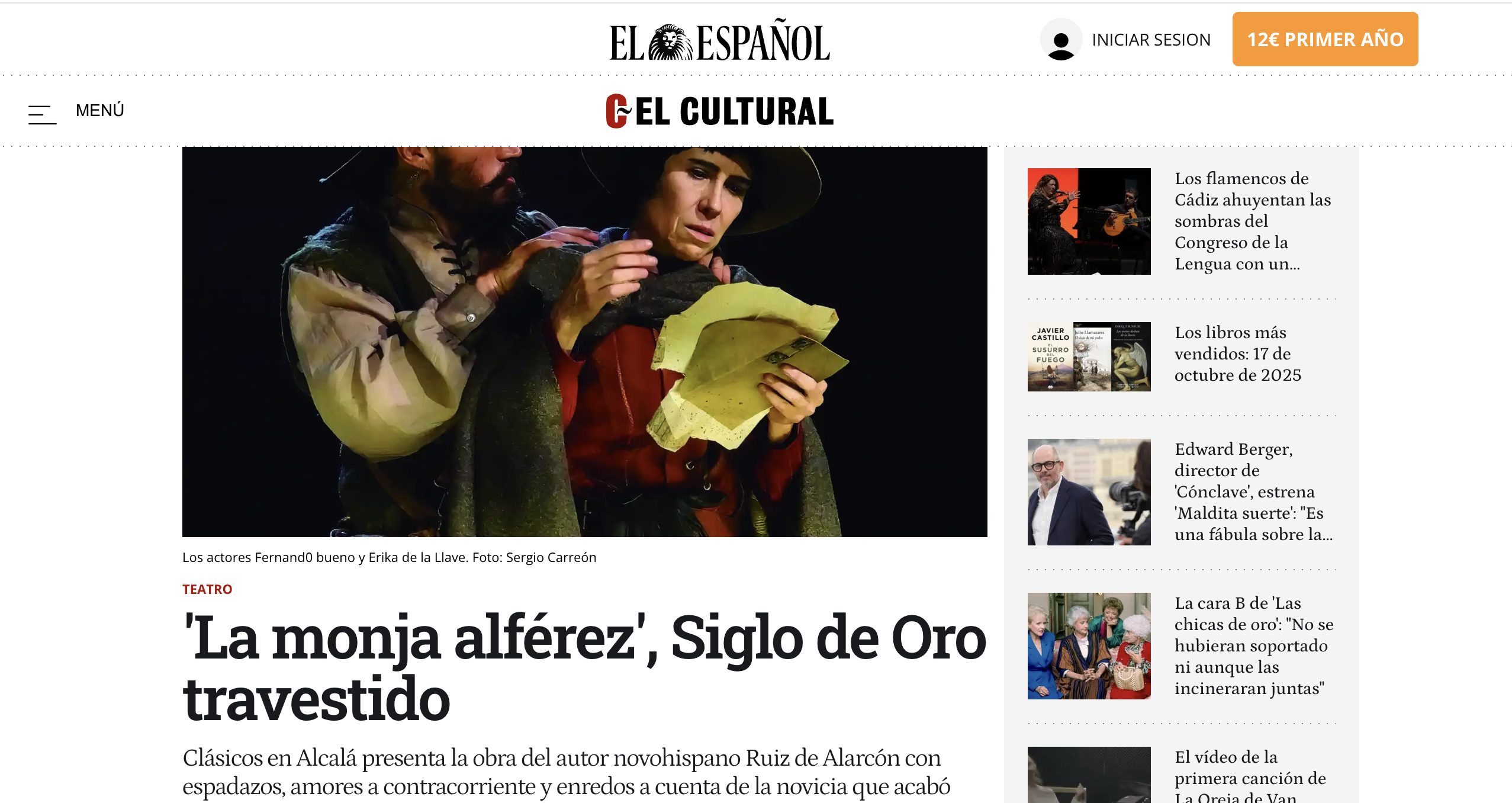
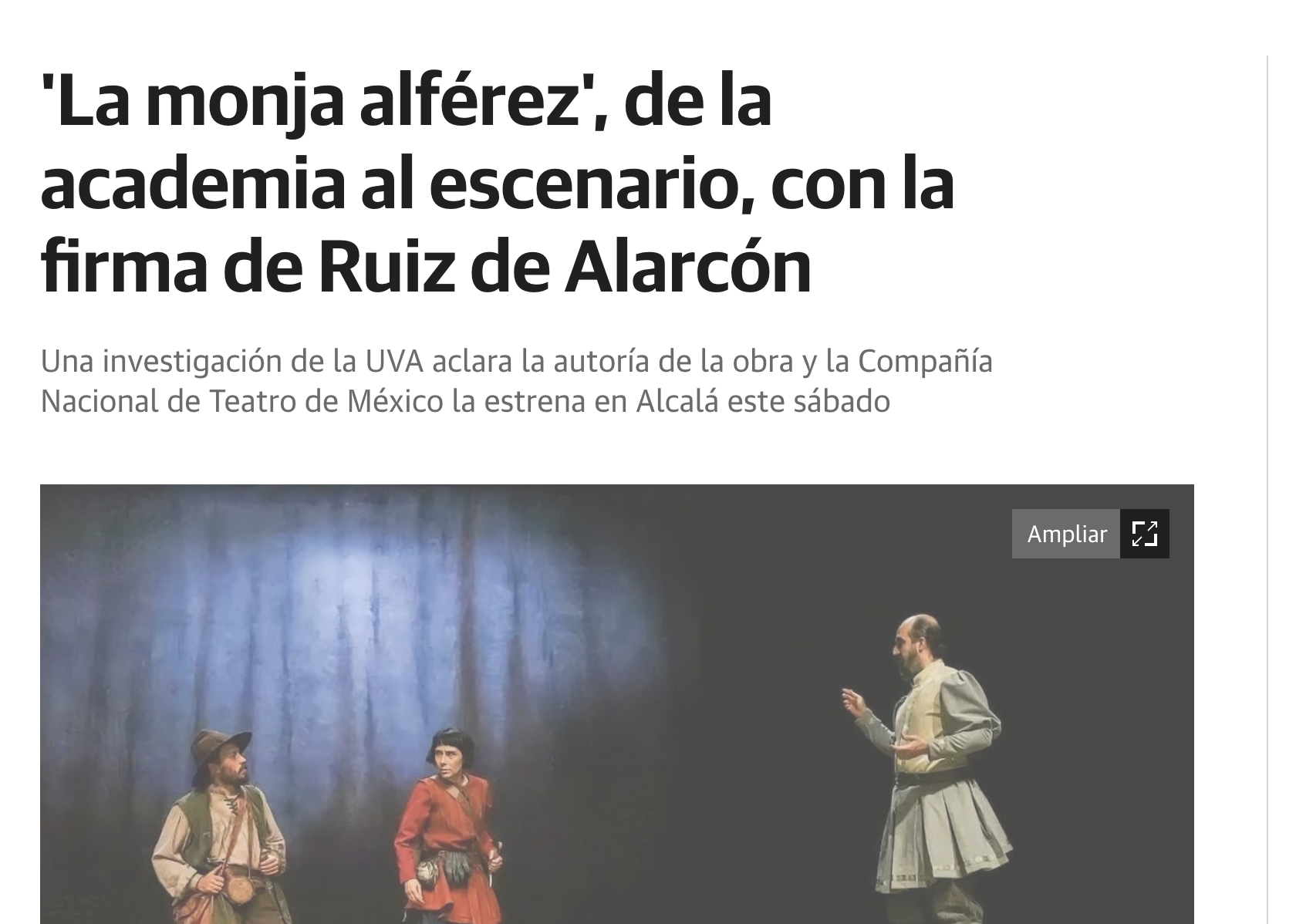
Vega García-Luengos, Germán. “Juan Ruiz de Alarcón recupera «La monja alférez».” En Rafael González Cañal; y Almudena García González (eds.), Sor Juana Inés de la Cruz y el teatro novohispano: XLII Jornadas de teatro clásico (Almagro, 9-11 julio 2019). Ediciones de la Universidad de Castilla-La Mancha, 2021, pp. 89–149.
Fernández Rodríguez, Daniel. Los primeros años del teatro comercial en España y el primer Lope (1560–1598). Anuario Lope de Vega. Texto, literatura, cultura, vol. 27, 2021, pp. 1–8. DOI: https://doi.org/10.5565/rev/anuariolopedevega.423.
Rojas Zorrilla, Francisco de. Obras completas. Volumen IX: Comedias sueltas. Ed. Alberto Gutiérrez Gil. Cuenca: Ediciones de la Universidad de Castilla-La Mancha, 2021. DOI: 10.18239/edcri_2021.29.00.
Ferrer Valls, Teresa; Ariadna Fuertes Seder; Raúl Peña Ortiz; Alejandro García-Reidy; Lola Josa Martínez; y Héctor Urzáiz Tortajada. ASODAT: una plataforma de información sobre el teatro clásico español a partir de bases de datos federadas. Talía. Revista de Estudios Teatrales, no. 3, 2021, pp. 45–57.
García-Reidy, Alejandro. Reseña de Juan Pérez de Montalbán, Obras, «Segundo tomo de comedias. Volumen 2.2», ed. general Davinia Rodríguez Ortega, Kassel, Reichenberger, 2020, 450 pp., ISBN 978-3-967280-07-4, y «Segundo tomo de comedias. Volumen 2.3», ed. general Claudia Demattè, Kassel, Reichenberger, 2021, 430 pp., ISBN 978-3-967280-19-7. Hipogrifo: Revista de Literatura y Cultura del Siglo de Oro, vol. 9, n.º 2, 2021, pp. 1129–1132. DOI: https://doi.org/10.13035/H.2021.09.02.76.
Ibáñez Mogrovejo, Henrry Alexander. Estudio literario y prolegómenos para una edición crítica de Las cadenas del Demonio de Pedro Calderón de la Barca. Pontificia Universidad Católica del Perú, 2021. Licenciatura en Lingüística y Literatura con mención en Literatura Hispánica.
Argensola, Lupercio Leonardo de; Teresa Ferrer Valls (ed. lit.); y Jaime Olmedo Ramos (ed. lit.). *Fábula de Dafne.* Kassel: Edition Reichenberger, 2021. ISBN 978-3-944244-90-7.
Martínez-Carro, Elena. “Hacia un corpus lingüístico del gracioso moretiano en las comedias palatinas.” 2021.
Gilabert, Gastón. El encanto de los dioses. Murcia: Editum, Ediciones de la Universidad de Murcia, 2021.
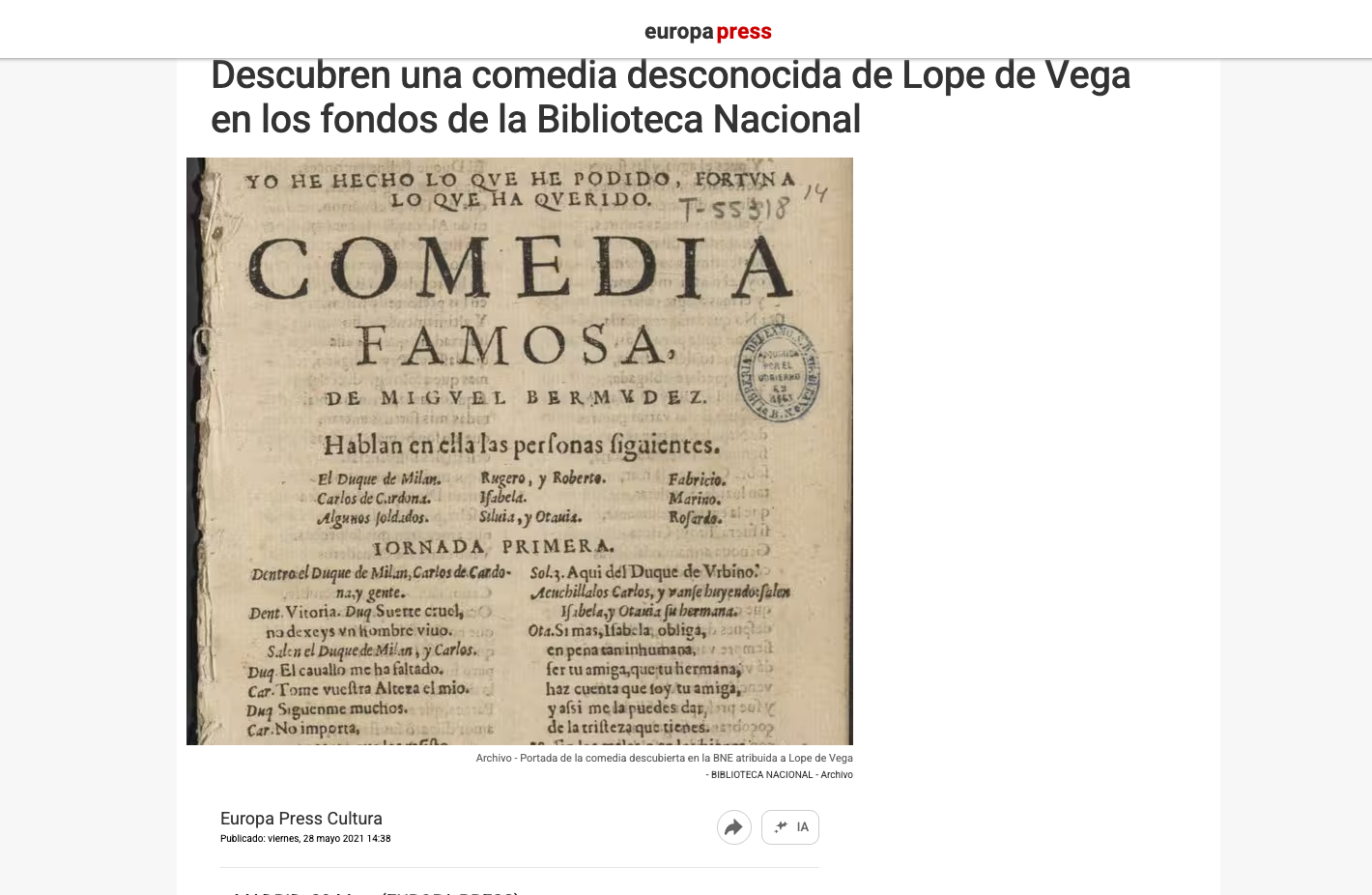
Madroñal Durán, Abraham. El renacer del Fénix: Yo he hecho lo que he podido, Fortuna lo que ha querido: una nueva comedia de Lope de Vega. Valladolid: Ediciones Universidad de Valladolid; Ayuntamiento de Olmedo, 2021. (Colección Olmedo Clásico, 17). ISBN 978-84-1320-133-7.
Horozco, Juan de. Manasés, rey de Judea. Ed. Mercedes de los Reyes Peña. Kassel: Edition Reichenberger, 2021, x + 214 pp. (Ediciones críticas, 227). ISBN 978-3-967280-16-6.
Lucía Megías, José Manuel. “El texto ante el desafío digital: ¿Nuevas perspectivas de análisis?” En María Ángela Celis Sánchez (coord.), Las humanidades digitales como expresión y estudio del patrimonio digital. Ediciones Trea, 2021, pp. 19–36. ISBN 978-84-9044-444-3.
Belmonte Bermúdez, Luis de, Agustín Moreto y Antonio Martínez de Meneses. La renegada de Valladolid. Edición crítica de Paula Casariego Castiñeira. Alicante: Biblioteca Virtual Miguel de Cervantes, 2021. (Colección Digital PROTEO, 18). ISBN 978-84-17422-85-1.
Zesiger, Marie. “Comentario sobre el estudio y la edición crítica de Las dos bandoleras y fundación de la Santa Hermandad de Toledo, comedia atribuida a Lope de Vega.” Boletín Hispánico Helvético, n.º 37–38, 2021, pp. 3–16.
Caballero, Iván Gómez. “Estudio estilométrico del teatro latino: a vueltas con Octavia y Hercules Oetaeus de Séneca.” Cuadernos de Filología Clásica. Estudios Latinos, vol. 41, no. 1, 2021, pp. 57–75.
Fernández Mosquera, Santiago. “La Lindona de Galicia, comedia de protagonista galega.” Consello da Cultura Galega, 2021. https://consellodacultura.gal/especiais/a-lindona-de-galicia/texto.php?esp=10291&mat=80231.
Napolskij, Milaydis Sosa. Native Language Influence Detection. Cross-Linguistic Analysis of Health Sciences Original Scientific Research Articles. 2021.
Peale, C. George (ed.). Francisco Agustín Tárrega. El renegado de Jerusalén. Santa Bárbara: Publications of eHumanista, 2021.
Tomasi, Giulia. “Las Humanidades Digitales y la base de datos MeMoRam: para un enfoque sistemático hacia los motivos en los libros de caballerías.” Historias Fingidas, núm. 8, 2020, pp. 129–156.
Medel, Rocío Alonso. “Reseña de Obras de Juan Pérez de Montalbán, Segundo tomo de comedias, dir. Claudia Demattè, Kassel, Reichenberger, 2019, vol. 2.1, 492 pp.” Hipogrifo: Revista de Literatura y Cultura del Siglo de Oro, vol. 8, no. 1, 2020, pp. 639–642.
Hernández Lorenzo, Laura. “Humanidades Digitales y Literatura española: 50 años de repaso histórico y panorámica de proyectos representativos.” Janus: Estudios sobre el Siglo de Oro, no. 9, 2020, pp. 562–595. DOI: 10.17979/janus.2020.0.09.10400.
Truan Aguirre, Elena. “La edición y los problemas de autoría en El saco de Amberes.” En Carlos Mata Induráin y Miren Usunáriz Iribertegui (eds.), «Melior auro». Actas del IX Congreso Internacional Jóvenes Investigadores Siglo de Oro (JISO 2019). Pamplona: Servicio de Publicaciones de la Universidad de Navarra, 2020, pp. 317–331. ISBN 978-84-8081-685-4.
Pérez de Montalbán, Juan (atr.). La monja alférez, famosa comedia. Edición crítica de Gabriel Andrés. Pesaro: Metauro Edizioni, 2020. ISBN 978-88-6156-161-8.
Merino Recalde, David. Estudios teatrales y Humanidades Digitales: un estado de la cuestión del cruce entre disciplinas en la investigación del teatro español. Trabajo de Fin de Máster, Universidad Nacional de Educación a Distancia, 2020. https://oai.e-spacio.uned.es/server/api/core/bitstreams/1d2d3f20-49f8-4c52-ac79-5242f5dd9a6a/content.
Fiore, Arianna. “Questioni di autorialità a proposito di tre commedie seicentesche: Pedro de Urdemalas tra Cervantes, Lope, Montalbán, Diamante e la scuola di Calderón.” Artifara, vol. 20, no. 2, 2020, pp. 53–77.
Rodríguez-Gallego, Fernando. “Problemas de autoría en comedias en colaboración: La adúltera penitente, de Matos Fragoso, Cáncer y Moreto.” Boletín de la Real Academia Española, t. C, cuad. CCCXXII, 2020, pp. 663–698.
García, Delia Gavela; y Juan Antonio Martínez Berbel. “Pico y Canente, de Luis de Ulloa y Rodrigo Dávila: un mito menor para una fiesta real.” Librosdelacorte.es, no. 21, 2020, pp. 223–246.
Moreto, Agustín. La confusión de un jardín. SAGA Egmont, 2020.
González Cañal, Rafael. Los sonetos de Rojas Zorrilla. 2020.
Emma, M. Texto, atribución y censura de Próspera y Adversa fortuna de don Álvaro de Luna. 2020.
Hernández Tornero, Celio. Investigaciones sobre la transmisión, recepción y tradición cultural de La dama boba: del manuscrito autógrafo a la era digital. Tesis doctoral, Universitat Autònoma de Barcelona, 2022. https://www.tesisenred.net/handle/10803/689108.
Demattè, Claudia. “Una nueva comedia en colaboración entre ¿Calderón?, Rojas Zorrilla y Montalbán: «Empezar a ser amigos» a la luz del análisis estilométrico.” Rilce, vol. 35, núm. 3, 2019, pp. 852–874. DOI: 10.15581/008.35.3.852-74.
Alviti, Roberta. “«No hay reino como el de Dios y mártires de Madrid»: problemas de identificación y de atribución.” Arte Nuevo. Revista de Estudios Áureos, núm. 6, 2019, pp. 90–109. DOI: 10.14603/6D2019.
Madroñal, Abraham. “Entre la historia y la leyenda. A propósito de Las dos bandoleras, comedia atribuida a Lope de Vega.” Anuario Lope de Vega. Texto, literatura, cultura, vol. 25, 2019, pp. 281–310.
García-Reidy, Alejandro. “La presencia escénica de Andrés de Claramonte en el Siglo de Oro a partir de las bases de datos MANOS y CATCOM.” Bulletin of the Comediantes, vol. 71, no. 1, 2019, pp. 135–154.
García-Reidy, Alejandro. “Deconstructing the Authorship of Siempre ayuda la verdad: A Play by Lope de Vega?” Neophilologus, vol. 103, 2019, pp. 493–510. DOI: 10.1007/s11061-019-09607-8.
Matos Fragoso, Juan de; Jerónimo Cáncer y Velasco; y Agustín Moreto. La adúltera penitente. Edición crítica de Fernando Rodríguez-Gallego. Alicante: Biblioteca Virtual Miguel de Cervantes, 2019. (Colección Digital PROTEO, 8). ISBN 978-84-17422-58-5.
Matos Fragoso, Juan de, Agustín Moreto y Jerónimo de Cáncer. El bruto de Babilonia. Edición crítica de María Rosa Álvarez Sellers. Alicante: Biblioteca Virtual Miguel de Cervantes, 2019. ISBN: 978-84-17422-68-4.
Barreda Villafranca, Cristina. Linajes y manos en La paloma de Toledo. Edición crítica y digital. Dir. Joan Oleza Simó y Jesús Tronch Pérez. Universitat de València, 2019. Programa de Doctorado en Estudios Hispánicos Avanzados.
Borja Macías, David Elías. Desarrollo de un sistema de análisis de autoría de textos de literatura de autores hispanohablantes. 2019.
Cavadas Docampo, Miguel. Estrategias de atribución automática de autoría aplicadas al teatro de Tirso de Molina. Dir. Pablo Gamallo Otero. Universidade de Santiago de Compostela, 2018. Traballo de Fin de Grao en Lingua e Literatura Españolas.